Next month will be 9 years since I first started my Creative Guitar Studio YouTube channel. Back in August 2008, I opened up the channel and I think I had one video.
It was really badly done, I was using a crappy $20 web-cam with a even more crappy lapel mic (that I bought at the dollar store). That was it. It was awful, I didn't take it too seriously because there was really no reason to...
In 2008, YouTube was not even allowing Individual Video Partnerships. That didn't happen until 2009, and it was really difficult to become a YouTube partner back then anyway.
So, as the years went on, and YouTube grew to become a major source of marketing, I started to notice something slowly happening across YouTube comments...
Basically, the comments from over the last 5 - 6 years started to get dumber, and dumber, and dumber. In fact, the comments of YouTube videos in general are becoming swamped with people incessantly complaining, or just being really weird about all kinds of very stupid ridiculous stuff.
People in the comments saying that; my guitar tone sucks, that my guitar is a piece of garbage, your technique is awful, you need to grow a beard, you need to wear different clothes, shave your head, get tattoos, your triplet rhythm is not in time with my metronome, your high "E String" is out of tune, you should get a tan, ....basically the level of stupid idiotic comments has just continued to become more and more insane.
Now, I've never given much regard to these people because when, or if I would ever go to their YouTube home pages it was always the same, there's nothing there, no videos, no subscribers, nothing.
The Tough Guy:
So, the one thing that I think it takes to be a really weird YouTube guitar person is to leave these incredibly stupid comments on, (not just mine, but on all of the), other guitar teachers YouTube channels.
Maybe just think before leaving your comments. Because when you leave really dumb comments - keep in mind, that they generally make little to no sense except maybe (just maybe) to you - because you wrote it. And, that means to the other 10,000 people, they are a complete waste of everyone's time. I want people who follow my channel to get smarter and become more successful on the guitar. And, I hope that viewers can focus on the content, focus on the message, and learn what you can take and do with the information.
The Grammar Police:
Try not to get all wrapped up in the nonsense of leaving really dumb comments. It is so not worth it, and all the really rude and nasty comments will just get deleted and you'll get blocked anyway.
So, if you're after the spotlight for being the next "Weird YouTube guitar person," trying to prove - whatever it is you're trying to prove - I probably won't stop you with this post. But, maybe - just maybe - I might get a few of you to think a little bit... Or... Maybe not.
PART ONE: In example one, we will make a study of an "AAAB," recurring formula in the key of "A Minor." The 3 time repeat of the "Part A" melody, (often called melodic ostinato) demonstrates the full effect of this technique by repeating three times over on the tonic chord. The "Part B" melody acts as a turnaround for either taking the idea out, or for behaving as a possible repeat opportunity.
Example two introduces the popular "ABAB" melodic formula in the key of "E Minor." This idea flips from part "A" to "B" measure by measure. The "Part A" statement occurs in measure one and three, with the "Part B" statement occurring on measures two and four. The flip from one to the other (bar by bar) pushes the melody along and anchors it in the listeners memory.
PART TWO: In example three, the formula switches to a slight variation of what we applied back in example one. The example three melody operates using an "AABA" formula in the key of "F Major." The principle statement occurs on measures one, two and four with the "B" part slipping in on measure three.
Of particular note in this example is how the rhythm punches are used off of the progressions, "Bb to F" major chords. When creating your own repeating melody lines, always consider the dynamic impact of the rhythm guitar part.
In example three, the formula switches to a slight variation of what we applied back in example one. The example three melody operates using an "AABA" formula in the key of "F Major." The principle statement occurs on measures one, two and four with the "B" part slipping in on measure three.
Of particular note in this example is how the rhythm punches are used off of the progressions, "Bb to F" major chords. When creating your own repeating melody lines, always consider the dynamic impact of the rhythm guitar part.
Paid members can download the handout along with the MP3 jamtrack in the members area at: CreativeGuitarStudio.com
As you embrace your obsession for music and for the guitar, you deny average. Maintaining this attitude fuels your potential and more skills will continue to be revealed to you.
Obsession is what keeps people motivated and more important, it is what keeps musical people creating. It is not money or awards but rather it is all of the possibilities for further growth out of creativity and motivation... The other evening I spoke to one of my students about the importance of obsession in a musicians career and the role it plays in having success. He was saying to me how difficult is was for him to stay driven with his guitar studies. And, how hard it is for him to remain motivated after reaching some levels of success that he's already had with his playing. Getting better at anything has a lot to do with learning how to get passed those internal and external obstacles and how to maintain your passion. Through my own musical life, average people tried to talk me out of my desire to be involved in the music business, suggesting my ideas were simply unrealistic fantasies. But, because I was so obsessed with music and with playing guitar, I thankfully didn't listen to them. Watch the Video:
THE "ENERGIZED" PERSONALITY: I don’t think people need to make a choice to be obsessed, I think we all are obsessed with something however, as we grow up we are talked out of it.
For instance, these days many young people are labeled by their elementary and jr. high teachers as; ADD, ADHD, OCD. Back when I was a kid, these labels didn't exist. Some kids were just "full of energy." And, the teachers found a way to communicate with them. Now, they put those kids on drugs. Having high energy is a gift, and back when I was a kid people actually celebrated that! If you want to reach for the stars, you'll need to deny the labels and instead embrace your energy as your gift - rather than a deficiency. And, no matter what other people say, don’t apologize for this. This energy is a compliment to you - not a hindrance.
WHAT IS "SELF-MOTIVATION?" Highly motivated people all have a fuel that gives them a can’t-quit, won’t-quit, accelerator-to-the-floor monster ambition inside attitude.
And, it grows as they grow - regardless of anyone's age. In fact, the older that highly motivated people get (and the more success they experience), the more obsessed they become with the reality that they can create more. This is why it is so important to embrace your obsessions and deny average. Chase your potential and even more potential will continue to be revealed to you. This is what keeps people motivated and it is also what keeps people creating. It is not money or awards but possibilities. You cannot get satisfied. Becoming satisfied with what you have done only means someone or something in your life or your belief systems has convinced you to settle for average.
Those who are stuck at "average" in the music business are threatened by the obsessed. Thus, they spend their time trying to stop the obsessed from being obsessed. The "average" are sadly too busy and too stuck trying to make sense of when they traded in their obsession for average! CREATING THE "OBSESSED" PERSONALITY: People who are crazy about guitar and crazy about learning music are heavily involved in a lot of musical areas. When I hire people for bands or for gigs, I am looking for other obsessed people who know how to direct their obsessive personalities.
I am constantly looking for people who are highly motivated, dreamers that can ride the music and love the musical experiences. That takes energy, commitment, responsibility, dedication. However, they better have their attitude on the same page. If their attitude is off-base from what is required for making the gig /project a success, it will scar both the motivation and the entire vibe of what it happening on the job.
CRUSH DOUBT - FUEL YOUR DRIVE: To keep up with the workload every day requires that you get energized. In fact, so much energy will be required from your crazy insane obsession with guitar and music, that there will barely exist any room for the fear of whether you'll accomplish your goals or not. To most people this seems next to impossible. But, it is vital to your drive and to the flow of your personality. Because when you are experiencing fear you start to shut-down, and self-doubt creeps in, and these feelings are a real killer. Once you get into a strong mindset of being able to quickly crush your self-doubt, then you'll be able to start embracing your obsessions - rather than explain or apologize for them, (which is what a lot of musicians do). By learning to flip everything around in your mind, to form better obsessions and to feed the drive within you - a new chapter will have to begin. In every area, you will start using any fear that arises to re-direct yourself into even more motivation. Doubt is a dream killer but fear can be an indicator of what you should do. Fear is an alarm bell for taking on new directions and to take on better ways to adjust your focus.
Most people are so filled with doubt that they are unable to believe in themselves. Sadly this has either been instilled in them by by others, or it has been developed in them by their own sef-talk.
There's an old aboriginal saying that goes something to the effect of, "Doubt is not native to the individual, it is something a person teaches to themselves." I absolutely agree with that.
BE OBSESSED WITH MUSIC - BE OBSESSED WITH LIFE: Most musicians, 99.999% of them, will reach a point where they are obsessed in their musical life. Sadly, in their very early years, school teachers, parents, relatives and even friends will tend to try and talk them out of their musical obsession. Or, they will be scared out of it by their own fears. It is truly a horrible shame. If you're obsessed with music now, feel happy and get excited. Most people never figure out what they are obsessed with in life, because they’ve been taught to deny their obsessions thinking they are nothing more than fantasies. Find a musical idea, a guitar technique, a musical piece, or a group project - something, anything musical, and drive yourself into obsession with it.
Quit denying your dreams. Own them and feed them because doing so has massive amounts of energy and creativity associated to doing it. Make a list of all the great musicians that you admire. Look at that list daily, pin it to the wall. And, realize that those musicians have walked this planet embracing their obsessions. And, you can too. When they failed, (yes, everyone fails here and there), they didn’t apologize or try to make others uncomfortable, or blame others. Instead, they embraced their obsession for music and poured everything into it. Were they neurotic? Maybe? Were they unstable? Could be? Did they contribute? Most certainly.
What is your most influential musical ability? What ability as a musician (if fully developed) will lead to your ultimate musical success. A skill so powerful it would cause you to be seriously in demand? Any guesses?
This past week I had an interesting thing happen in the studio. It all started when one of my students wanted to get a handle on the intro. riff and the chord structure for the pop song Despacito (by Luis Fonsi).
In case you haven't heard of this song, it's a huge hit right now. It was covered by Justin Bieber, and just to give you an idea of the reach that this piece has received, the YouTube video has over 2 Billion views, (YES, that was BILLION). It's a major hit.
My student wanted to review the chords and the intro. at the end of one of his guitar classes and since time was tight, we figured, let's jump online and grab a TAB chart to quickly be done with it. Well, as you'll find out (in the video below), it wasn't as easy as we thought it would be. Even with a hit pop song as huge as Despacito...
When we took a quick look over the guitar TABs for this piece (on everyone's favorite guitar TAB website "Ultimate-Guitar.com"), there were a few breakdowns of the song for chords and lyrics, and for the songs intro. But, nothing was really accurate. This really surprised us, because the song is huge, so you'd figure that there would have been a solid well made chart posted already. It's been on the charts soaring away for 6 months. Here's where we get to tie into the title of this post. In situations like these, you'll need to rely on your most influential musical ability, and that is your ear. If you can listen to a song and fully comprehend how to play it, (notice I used the phrase "How to Play it"), you'll be at that point as a musician where you're autonomous. You can completely function on your own. It all comes together once you have this ability down 100%. So, back to this pop song. First of all, it's a simplistic piece, (as most pop songs are). The chord changes are common fair, and once you know what they are, there's no complexity whatsoever.
THE INTRO. GRABS THE GUITAR LISTENER: This songs intro. is the reason why guitarists have an interest in learning it. The riff at the start of the tune is all guitar. It has a Spanish flair and offers some interesting sound. However, we could not find a decent break down of it that actually sounded like the recording anywhere. Again, here's where that most important musical attribute comes in again. Your ear! If you spend a few minuets messing with the intro. riff and then move on to how the chord changes sound after it wraps up, you discover that placing a capo at the 7th fret solves all of your problems and the tune is easy to jam on all the way through. It becomes a "No-Brainer."
LEARN TO HEAR - DEVELOP YOUR EAR: Knowing the various boundaries and limitations of the guitar helps. Knowing how the scale tones sound, and when to apply the use of a capo will all go a long way to helping you nail down song parts - fast. This business of lifting off song parts (quickly) is a critical skill. When you get that call asking you to learn 20 new songs for a gig the following week in a club, or private function - you better be able to pull it together and make yourself a pile of song charts. Because put it this way... you'll never learn three sets of material fast enough any other way, and the likelihood of a band supplying you with TAB and chord charts to read at the gig is almost nil. MORE PAID GIGS = MORE PAID BILLS: Calls like the one I mentioned above happen a lot to a busy working musician, so having a great ear makes all of the difference in the world when you need to learn songs - and learn them fast. If you're an aspiring pro, and paying your rent depends on getting gigs, a great ear is a must have skill. When household bills are due, you need to have the cash on hand to get them paid. And, a fantastic ear will get you known, it will keep you working and keep those bills paid every month.
Blues arpeggios offer guitar players a fantastic way of outlining the chords that make up our typical blues progressions.
Whether playing a 12-bar, 8-bar or a 16-bar blues, outlining the harmony of a blues jam with arpeggios will offer guitarists an interesting sound every time... The goal of this lesson is to demonstrate how guitar players can break out of the blues pentatonic scale through the use of blues arpeggios. Each chord of our most common blues harmony is a dominant 7th. This allows us to apply the sounds of the "Dominant 7th Arpeggio" to outline each of the chords found in a typical blues.
UNDERSTANDING BLUES ARPEGGIOS: The Blues Arpeggio is a Dominant 7th arpeggio and represents the 1st, 3rd, 5th and minor 7 tones from the Dominant 7th Chord. These tones create unique fingering patterns on the neck that work well to highlight the chord tones found in a typical blues harmony. EXAMPLE 1). 6th String Root "Blues Arpeggio"
The above shape can be played anywhere on the neck
The pattern for the Blues Arpeggio is based entirely upon the chord tones of a "Dominant 7th" chord. This means that the outline of the Dominant 7th is the primary goal. The application of this sound can be used on its own, or in conjunction with the "Blues Pentatonic Scale."
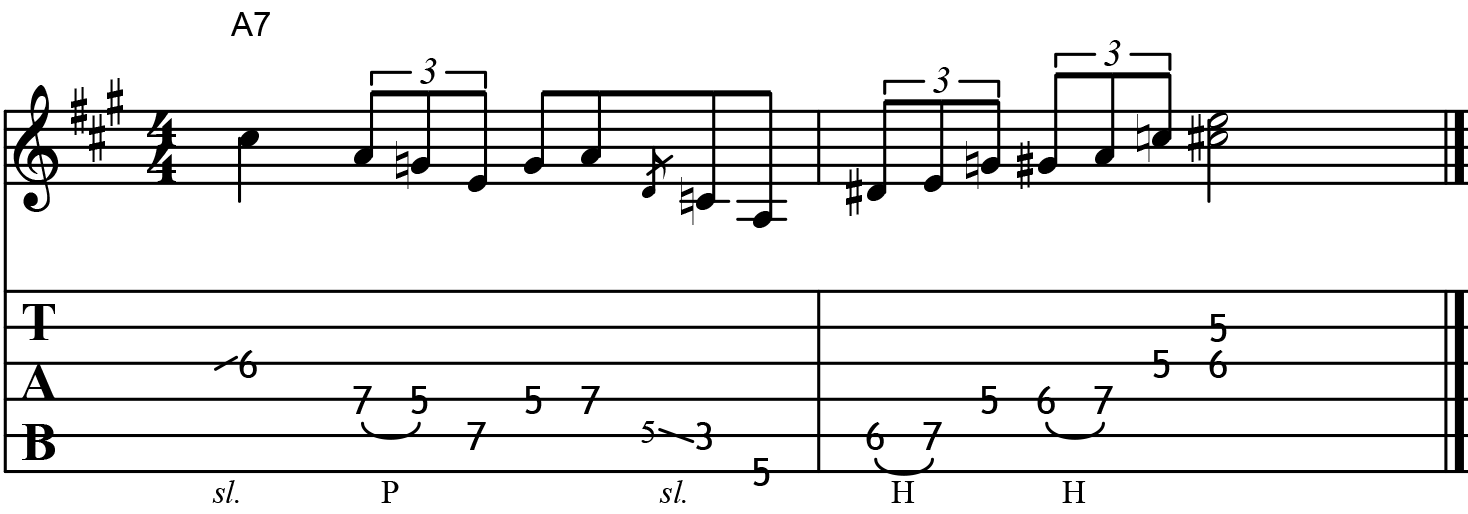
APPLYING THE BLUES ARPEGGIO: The application of this sound is unique and can offer a strong connection in a Blues situation. The example below applies this arpeggio to the first and fourth chords of a Blues in the key of "A." EXAMPLE 2). Applying the "A and D" Blues Arpeggios.
Coverage of each chord in example two operates around the tones of the "A7" chord tones and the "D7" chord tones. This idea sounds great on its own, or it can be combined with the Blues Scale for another interesting sound. EXAMPLE 3). Combining the "A" Blues Arpeggios with the "A" Blues Scale.
EXAMPLE 4). Combining the "A" Blues Scale with the "D" Blues Arpeggio
The combination of both Blues scale and the Blues arpeggio can create some fantastic melodic ideas. The effect of either combining these ideas, or isolating the use of just Blues Arpeggio allows for an opportunity to create all kinds of unique melodic ideas.
GOING FORWARD: Begin by recording a loop of an "A7" chord played in a blues feel. Practice applying the "A Blues" Arpeggio over the chord jam. Discover lines and sounds that sound interesting. Then, add in the mix of an "A Blues" scale along side of the "A Blues Arpeggio." Mix and match sounds and phrasing using both ideas. Come up with cool sounding lines that integrate well between the chord changes. Record another progression that applies two chords across 4 measures. Record two measures of an "A7" chord and two measures of a "D7" chord. Practice using only the Blues arpeggios at first. Then, when the arpeggios are feeling good, add the use of an "A Blues" scale mixed against the use of "Blues Arpeggios" over the progression. Record an eight bar blues and apply the same ideas of Blues arpeggios and scales. Then, record a 12-bar Blues and apply the same approach yet again.
There are more guitar strumming patterns applied in songs than can be taught. So, the guitarist needs to understand how to control their strumming in a way where they can create any strum pattern they hear.
This is the "trick" to learning how to strum. The good news is that this is a technique and it can be mastered over time...
Being able to control your strumming up to a level where you can duplicate what you either hear on an album, or what you hear in your head is vital. This skill comes down to gaining true mastery over rhythm guitar. Unfortunately, it is easier said than done. Strum patterns can be complex and without absolute control over the strum hand, you'll find it very difficult to play the endless amount of strumming patterns used in music. However, if you can master the exercise I'm about to show you in this guitar blog post, your strumming will drastically improve.
The idea centers around hearing ideas in your head and working at duplicating them. So, this makes the exercise very autonomous. You will self-govern how the exercise operates and you will be in control over what happens with the way you interpret the exercise. Because you will be making decisions about the feel of the strumming (to a significant degree), you will also need to perform constant self-checks to make sure that the ideas you are developing make sense as to what you hear in your head.
CONNECT TO YOUR HEAD: As musicians, we all hear and feel patterns and grooves in our minds. This is a strong connection for almost all musicians because musical people all naturally enjoy feeling and expressing music. Since we all like to sing songs in our head and we naturally hear groove in our mind, we already have access to many different patterns for rhythm and strumming. We just need to understand how to get them out. THE CONNECT EXERCISE: Grab your guitar and tap your finger on the sound board. Play around with creating a simple recurring meter as you tap. Nothing too crazy, keep it simple. Just be sure that you're developing a recurring groove. Once you've firmly established a beat through tapping your finger on the guitars sound-hole, begin visualizing what that beat would be like to strum. Decide where you'd strum down and where you would have the strum move upward. Be clear about this by calling the moves out loud. call out; "Down" "Down" "Up" "Up" "Up" "Down." Notice what you imagine it is going to feel like to do this for real.
Next, grab the guitar and translate these moves to some live playing. When you execute the pattern of your strumming, continue calling out the strum directions. Notice where your body takes you. Do the strums feel accurate? Or, perhaps where you thought there should be a "Down" there really needs to be an "Up." Pay attention to what "Feels" correct. The "Connect Exercise" works great to take any rhythms and strumming feels that you have floating around in your mind and make them a reality. As you get better at the "Connect Exercise" move on to listening to strum patterns off of your favorite recordings and use the same process. You'll be able to match them us just like you did with those simple taps that you made on your guitar soundboard. It will take a period for the exercise to create a good rhythm inside you that accurately matches recordings. But, with some effort, you'll begin getting much better at building the connections. And, as long as you strive for the best possible feel, your connection to performing any type of groove will simply get better and better over time.
Pattern picking is one of the most important skills that acoustic players need to develop. This lesson combines several pattern picked ideas to allow for everything from simple to complex plucking.
The goal of the lesson is to learn a number of different ways for adding more picking pattern variety through simplicity of technique...
The examples cover picking patterns and how they relate to both the chord changes and the tonal range of the chord voicings. When applying picked phrases, players will learn how to integrate multiple picking patterns, add more variety to note layout across the neck and how to balance consistent picking patterns along with more complex phrasing.
PART ONE: In example one, we'll make a study of how a simple consecutive picking pattern can operate in more dynamic ways through the use of double-stops. A starter phrase in example 1a, takes a key of "C Major" consistent pattern and then enhances it in example 1b. The second idea applies double-plucked tones upon the downbeats.
Example two explores adding variety with phrases that are delivered across a part in more than one way. In example 2, the picking pattern covers a key of "G Major," (D Mixolydian), harmony. The chord changes evolve across the measures using a four-string pattern layout.
This example is excellent for helping players realize how patterns are often altered in order to compensate for both string sets, as well as, for the lowest chord tones.
PART TWO: The second part of the lesson plan focuses on balance and consistency. In example three, a key of "E Minor" progression balances two different picked phrases. In measures one and three, a phrase that includes a fast 16th-note triplet idea is balanced against two unique melodic phrases in measures two and four. The result is a relatively easy to play phrase that sounds somewhat complicated but yet maintains a connected sensibility across all of the chords.
In example four, one of the most overlooked ideas for supporting melodic lines in acoustic guitar is demonstrated. The principle involves layering a lower register octave directly related to the melody note from the simple line.
In example four, one of the most common techniques for applying picked patterns is covered. This technique involves the application of a consistent picking pattern across the entire group of chords used in the harmony. This "G Major", (D Mixolydian) chord progression is covered with a consistent picking pattern that applies an identical interval pattern along each measure.
Songs like "Dust in the Wind," by Kansas and "Landslide" by Fleetwood Mac are excellent examples of this concept in use.