Play These 4 Notes First Thing in the Morning (CHANGE YOUR WORLD!)

Waking up feeling like you have little to no creativity is extremely common, especially if you aren't working on any new songs or when you don't have any new riffs that were being studied from the days before...


In this video, I’m going to show you one of the best routines that I know of. It's easy to do this routine every morning to help loosen up your hands, calm your creative mind and in turn increase your creativity for the rest of the day.

Much of what you are trying to overcome is the unrest from a state of mind that will often hold you back from developing three things. Our best potential, our most unique /creative playing and our ability to tap into that "performance" mind-set.

The routine in this video will go a long way to help hit these key areas and allow you to achieve a better state of creativity more quickly, so as not to take up much time when you start your playing day.


THE BENEFITS OF A CREATIVE ROUTINE:
If you have a hard time getting into a balanced /creative headspace at the start of your playing day I have an excellent 4-Note idea that you can use to start off with every morning.

This exercise is something that I learned a long time ago and have since taught it to many of my own private students.

This study has become one of the most valuable things that I like to do to start my day off. And, if you get used to doing this it will help you with being able to move forward in your day with a more relaxed mindset, (or what some people call a more Zen place musically - where you just feel more at ease and more at peace with everything).

This approach that I’m about to go over here will allow you to start your day more; balanced, and help you to get working on musical ideas in a more calm and focused state of mind.

The added benefit of this exercise is that it's simple to work on because it’s all based upon the most balanced intervals that are found in music, (which means that the exercise centers around the balanced sound of Major, Minor and Perfect Intervals).

On top of everything else, the exercise is a very cool musical idea that comes across with a lot of melodic possibilities. Plus, it’s a routine that I think you’re going to enjoy doing in the morning to start off your musical day on the most creative musical path.


LATERAL POSITION LAYOUT:
To get started, let's cover a group of notes that we can use as an "along the neck track" of positions for applying our 4-note routine. The initial neck positions that we’re going follow on the fingerboard will be lateral and will look like the "Fig. 1" diagram below.

Figure 1). Lateral note group


Next, we will establish a fingering pattern for our four note structure. It’s a fingering that looks like the chord diagram shown in the "Fig. 2" image below.

Figure 2). Four-note fingering
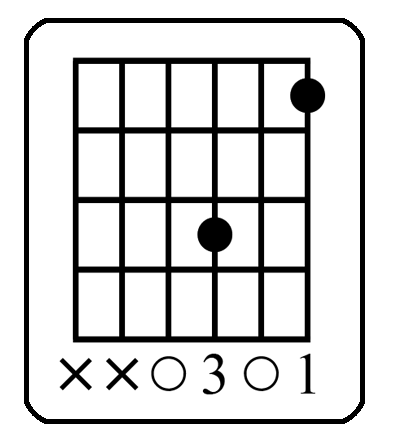

NOTE: In the YouTube video, a secondary "optional" fingering is discussed. That fingering is provided in the "Fig. 3" diagram below. Try using it as an option.

Figure 3). Optional four-note fingering


                         ____________________________________________________

There's a second group of patterns and another creative exercise that relates to this lesson, so I wanted to take a minute to let you know, that if you want to learn even more about this topic, (along with more about the basics - like scales and theory), I have a GREAT offer for you...

With any donation over $5, or any merchandise purchase from my Tee-Spring store, I’ll send you free copies of THREE of my most popular digital handouts.

One is called, “Harmonized Arpeggio Drills” (it’ll train you on developing your diatonic arpeggios).

Another one is my “Barre Chord and Keys” Handout which includes the four most popular barre chord patterns, an explanation page showing all the key signatures, along with a chord progression that applies barre chords.

Plus, you’ll get my Notation Pack! It has 8 pages of important guitar worksheets for notating anything related to; music charts, guitar chord diagrams, and TAB.

As a BONUS, (from my "Over 40 and Still Can't Play a Scale" video), I'll also throw in a breakdown of all of the chords that are diatonic to the "F Major" scale.

As an EXTRA BONUS for my Phrygian Dominant video, I'll also throw in a breakdown featuring all of the chords that are diatonic to the Phrygian Dominant scale.

Just send me an email off of the contact page of CreativeGuitarStudio.com to let me know about either your donation or your Merchandise purchase and I’ll email you those digital handouts within 24 hrs.    

                       ____________________________________________________


THE CREATIVE EXERCISE ROUTINE:
Next, let's break down the concept of how we would actually do this creative routine. So far, we have organized a lateral note position group (see figure 1), that we’re going follow with a vertical fingering layout (figure 2 and 3), across the neck.

The application of this exercise will focus on fitting our four-note chord fingering into each position.

When we put everything together, they create four 4-note fret-board examples that we can have some musical fun with. Here’s how they sit on the neck:

Shape 1).


Shape 2).


Shape 3).


Shape 4).


CONCLUSION:
As you can tell these note groups are all based upon a simple fingering pattern which is then combined with the lateral "along the neck," positions that we can apply them into for a quick and easy creative study.

Together, the position layout and chord idea (of four notes), end up working extremely well as a fun creative exercise to start off the day.

And, the other added benefit is the balanced /peaceful (Zen) musical sound that is generated. The main reason why this chord fingering sounds so calm and relaxed has to do with how the groups of intervals are combined to create the sound off of each fingering pattern and fret-board position.

The interval combinations focus a lot on the Major 6th but there’s also emphasis on the Major 9, along with the Perfect 5th, the Minor 7, and the Major 3rd. When everything comes together, we have a smooth connection to the key signature of (in our case today) of “G Major.”

And the really cool part is that you can do this in other keys as well. Adding open strings just compliments the entire concept, so if your key permits, you'll want to definitely consider adding open strings around your chord pattern fingering.

As we saw with our example, if we simply add a low register tone of “D” open 4th string, in the bass we achieve a model effect, and that sounds really cool.

Before we wrap up this lesson, be sure to take a moment and watch how I have some fun with both the fingering shape and with the fret positions by jamming out some improvised ways of playing through this routine.You can find it on the YouTube video at the time stamp of [11:31].


___________________________________________________

GET GOOD NOW - JOIN THE MEMBERS AREA

Join Now

Guitar Chords | F Chord | Guitar Notes | G Chord | C Chord | D Chord | Guitar String Notes

How to Learn ALL the Guitar Chords (AND HOW NOT TO!)

Every chord practice session should be balanced with a healthy dose of routine diatonic harmony to make sure that you don’t leave yourself lacking in the department of realistic chord application...


If the three primary chord qualities don't get applied musically, (major, minor and dominant chords), we wind up causing imbalances in our application of them. This will often lead to poor chord performance down the road.

In this video, I show how to study chords so that you keep your application of them relevant and how to master more than one fret-board region to be able to apply them more fluently.

If you practice chords using a study approach like the one outlined in this video, you'll find that your versatility for using them and your memory of them will literally go through the roof!


THE STUDY OF GUITAR CHORDS:
Learning chords on the guitar is one of the most important things that we do as students of this instrument.

However, one big problem for a lot of guitar players is that they will tend to go about their study approach in a way that doesn’t allow them to both memorize and to be able to use all of the primary chord fingerings, and to know how they are most commonly used in music.

In this lesson I’m going to do two things to try and help solve that.

First, we’re going to take a look at an excellent chord practice system. Then, we’re also going to also run through a way that composers use chords to enhance their music.

The musical aspect is important because you need to become familiar with the most common chord movements that get used in all of the songs that you’ll practice in the months and years you have in front of you as a guitarist.

So, let’s get started with the first exercise…


OPEN POSITION EXERCISE:
One of the best chord progressions to study is a called the diatonic “I-VI-II-V” progression. Diatonic means that all of the chords are part of the same key.

The “I-VI-II-V” numbers are intervals that relate to the steps of the scale from whatever key has been assigned to the music.

This progression is valuable because it integrates two major chord qualities along with two minor chord qualities - all done from within the same key. The key that we’ll study for our exercise will be the key of “D Major.”

Let’s check out what’s happening right now with this “I-VI-II-V,” chord progression - in the key of “D Major.”

Example 1a). THE PROGRESSION ( I – VI – II – V )
Key of “D Major”


Example 1b). THE CHORD PATTERNS ( I – VI – II – V )
Key of “D Major” = “D” “Bm” “Em” “A”


Composers will often enhance the arrival of one or more of the “Diatonic” chords with a chord type that is not; Major, or Minor. Instead of those chords, composers will apply what are called secondary chords.

These secondary chords are chords that are of a quality that is referred to as, “Dominant 7th.” Once you learn about; Major, Minor and Dominant 7th chords, you have essentially learned the foundation of the three chords that are the most important in music.

To hear just exactly how this would work, we’re going to implement a, “Secondary chord,” into that “D Major” progression that we had just worked on a few minutes ago.


Example 2a). SECONDARY CHORD ( I – VI – II7 – V )
The application of a “Secondary Dominant” chord on the “II-chord”


Example 2b). (E7 chord voicing)


                         ____________________________________________________

I wanted to take a minute to let you know, that if you want to learn even more about scales and theory I have a great offer for you.

With any donation over $5, or any merchandise purchase from my Tee-Spring store, I’ll send you free copies of THREE of my most popular digital handouts.

One is called, “Harmonized Arpeggio Drills” (it’ll train you on developing your diatonic arpeggios).

Another one is my “Barre Chord” Handout which includes a page showing all the key signatures along with a chord progression that applies barre chords.

Plus, you’ll get my Notation Pack! It has 8 pages of important guitar worksheets for notating anything related to; music charts, guitar chord diagrams, and TAB.

As a BONUS, (from my "Over 40 and Still Can't Play a Scale" video), I'll also throw in a breakdown of all of the chords that are diatonic to the "F Major" scale.

As an EXTRA BONUS for my Phrygian Dominant video, I'll also throw in a breakdown featuring all of the chords that are diatonic to the Phrygian Dominant scale.

Just send me an email off of the contact page of CreativeGuitarStudio.com to let me know about either your donation or your Merchandise purchase and I’ll email you those digital handouts within 24 hrs.    

                       ____________________________________________________


MOVABLE (BARRE CHORD) EXERCISE:
As the title of this video states, I’m showing you how to learn all of the chords on the guitar, through this very effective “I-VI-II-V,” chord progression exercise.

And, as you’re finding out, the “I-VI-II-V,” method has to do with learning one of the most valuable chord progressions, and then taking it and learning to modify it with the concept of using “Secondary Chords.”


But, what you don’t want to do is neglect other fret-board areas when you study your chord ideas. Too often guitar players leave chords exactly where they first found them from a song that they’d practiced.

That’s how “Not” to practice your chords. So, in respect of not leaving any group of chords in only one area of the neck, we’re going to re-locate the chord progression we had just studied over to another fingerboard area of the guitar. We’ll keep it in the same key, but the chords will all be new shapes on the fingerboard.


Example 3a). THE PROGRESSION ( I – VI – II – V )
Key of “D Major” (mid-neck region)


Example 3b). THE CHORD PATTERNS ( I – VI – II – V )
Key of “D Major” = “D” “Bm” “Em” “A” (mid-neck region)…


Next, let’s add our secondary dominant chord. I’ll play the chord changes once again, but this time with the VI-chord of “Em” converted to an, “E” Dominant Seventh chord…

Example 4a). THE PROGRESSION ( I – VI – II7 – V )
Key of “D Major” (mid-neck region, w/Secondary Chord)


Example 4b). THE "E7" CHORD PATTERN


CONCLUSION:
Using the “I-VI-II-V,” chord progression (the way we covered it in this video), will go a long way to help you learn your chords and move through all of the keys so you really get to know the patterns for both Major and Minor...

If you also take the, “I-VI-II-V,” progression to other areas of the neck, what you’ll start to discover is how to play the Major and Minor shapes all across your guitar as well as understand other options for all the important Major and Minor chord shapes.

Then, if you take things to the next level and you also learn how to add in the Secondary Dominant chords, you’ll have covered the three main chord qualities that are found in music!

So, taking guitar chord practice this far, (in an exercise like I’ve covered here), will really help you get to know how to perform the; Major, Minor and Dominant 7 chords (all over the neck), and you’ll learn to understand how they’re applied in pretty much any of the most popular top-40 songs out there!

___________________________________________________

GET GOOD NOW - JOIN THE MEMBERS AREA

Join Now

Guitar Chords | F Chord | Guitar Notes | G Chord | C Chord | D Chord | Guitar String Notes

ONE Clever Trick All Guitar Players Should Know!

I don’t care what you have planned for your next guitar practice session, but you better make room for what I’m going to show you in this important video guitar lesson. In it, I’m going to reveal to you the number one thing you need to do every single time you practice a new; scale, riff or lick...


Some guitar students may have been given alternative advice, where they've been told that learning alternate versions of scales, licks and riffs isn't necessary. I’m going to tell you, (if this sounds like advice that you've been given), what you have been told is just bad advice.


DEFINE WHAT and WHERE YOU PLAY:
I’m going to get right to it today, there is one clever trick you need to be doing every time you work on laying out anything on your guitar neck. And, that is you've gotta take into consideration how every idea that you learn can be played along the guitar in two directions of travel.

These different directions are;
  • Upward toward the guitar’s body
  • Down to the direction of the guitar’s head-stock

With every riff you play, and every solo, (or guitar lick) you learn, you’d better understand how the part that you're studying on guitar would sit on the guitar in both directions, (upward and downwards the neck).

Some people might say, "look I’ve been taught to only learn a riff or a solo exactly as it was played on the original recording by the band."

Okay fair enough, but, if you only do that, you’re going to miss out on how to expand those ideas on the fingerboard. Also, if you only learned a part as to how it was played on the recording you’re just limiting yourself to one pattern on the frets.

Working out ideas so that you have them understood in only one way will unfortunately limit your guitar knowledge and that type of study will leave you on a shaky foundation.

In this lesson, I'm going to show you how to take scale patterns plus guitar licks and lay them out on the guitar so that you can learn how to view all the notes in both directions.


Example 1).
Our first example is going to be using the shape of a “D Major” scale pattern traveling toward the guitar’s body, playing notes located on the lower register strings. The pattern that we’re going to use - looks like this…

Scale Scale Diagram


Next, let's establish a melodic phrase using this scale pattern on the neck. That way what you can start to better understand is more of the playing options that this neck layout of our example scale can offer us with the music that we play.

Guitar Lick Example


Example 2).
Our second example is going to again use the shape of a “D Major” scale pattern but this time traveling toward the guitar’s head-stock.

Guitar Scale Diagram


Here’s a melodic idea so we can find out what this direction of scale tones will be able to offer us in our playing.

Guitar Lick Example


                         ____________________________________________________

I wanted to take a minute to let you know, that if you want to learn even more about scales and theory I have a great offer for you.

With any donation over $5, or any merchandise purchase from my Tee-Spring store, I’ll send you free copies of THREE of my most popular digital handouts.

One is called, “Harmonized Arpeggio Drills” (it’ll train you on developing your diatonic arpeggios).

Another one is my “Barre Chord” Handout which includes a page showing all the key signatures along with a chord progression that applies barre chords.

Plus, you’ll get my Notation Pack! It has 8 pages of important guitar worksheets for notating anything related to; music charts, guitar chord diagrams, and TAB.

As a BONUS, (from my "Over 40 and Still Can't Play a Scale" video), I'll also throw in a breakdown of all of the chords that are diatonic to the "F Major" scale.

As an EXTRA BONUS for my Phrygian Dominant video, I'll also throw in a breakdown featuring all of the chords that are diatonic to the Phrygian Dominant scale.

Just send me an email off of the contact page of CreativeGuitarStudio.com to let me know about either your donation or your Merchandise purchase and I’ll email you those digital handouts within 24 hrs.    

                       ____________________________________________________


Example 3).
Our third example is going to use the shape of a “B Minor” scale pattern on the upper strings and traveling toward the guitar’s body.

Guitar Scale Diagram


Here’s a melodic idea so we can find out what this direction of scale tones will be able to offer us in our playing.

Guitar Lick Example


Example 4).
Our last example is going to once more use the shape of a “B Minor” scale pattern on the upper strings but now traveling toward the guitar’s headstock.

Guitar Scale Diagram


Here’s a melodic idea so we can find out what this direction of scale tones will be able to offer us in our playing.


Guitar Lick Example


CONCLUSION:
All of the world’s greatest guitar players have worked this one clever trick into their practice routine. And, if you can also start to do this with every; scale, riff, lick and solo that you study, you’re going to develop an awareness for how these ideas sit on the neck that goes well beyond the knowledge that you’d get from only learning something in one particular way.

You gotta include some other directions of study when it comes to every musical phrase that you practice as a guitar player.

So, make sure that with every; scale, riff, lick and solo that you practice you explore how the notes sit on the neck toward the guitar’s body, as well as, toward the guitars headstock.

And, as you do this, you’ll really build your neck knowledge for notes on the fret-board. And, this will ultimately have you twice as aware of how music operates on the guitar – making you twice the guitar player in the process.


___________________________________________________

GET GOOD NOW - JOIN THE MEMBERS AREA

Join Now

Guitar Chords | F Chord | Guitar Notes | G Chord | C Chord | D Chord | Guitar String Notes