FIVE Guitar Exercises that Change EVERYTHING! (DO THESE)

Guitar Technique workouts and their exercises can be a real lifesaver when it comes to better guitar playing! Especially those times when you're feeling like your technique is not helping you play as accurately as possible and its not getting you to the notes that you need to perform.


In this video, I’m going to give you a "Total Guitar Workout" routine with EVERYTHING you need for perfecting your left and right hand coordination and dexterity. These exercises will include workouts for each hand and help you build greater flexibility and more accuracy.


TECHNIQUE STUDY:
The key to the effectiveness of your guitar technique workout is that it must pair every exercise together in a way that allows you to train for greater excellence within the technique that you need to improve. This means, the more exercises the better.

Remember each technique must improve to a higher degree than would be possible if you only stuck with just one single exercise. Also, keep in mind that the workouts need to be brief (3-5 min.), and be sure to always use a metronome.

In this lesson we’re going to continue with the ongoing study of Guitar Technique. This topic is one of the most widely requested topics because not only is having good guitar technique in high demand for guitar players, but it’s a necessity.

Without good technical skill everything else we want to accomplish as guitar players will feel more difficult. So, in this lesson we’re going to focus on a group of exercises that target the picking hand and the balance, as well as, coordination for tracking notes you pick.

Plus, along with that, we’ll also have a couple of great exercises for developing more accuracy and control for the agility level of the fretting hand.

So, let’s get started with learning these FIVE guitar exercises that will start making serious changes to everything you play…


Exercise 1).
Picking study on 2-strings (movable laterally)


Exercise 2).
4-fret “in-position” triplet picking study in 5/4 time


                         ____________________________________________________

I wanted to take a minute to let you know, that if you want to learn even more about scales and theory I have a great offer for you.

With any donation over $5, or any merchandise purchase from either my Tee-Spring, or my Zazzle store, I’ll send you a free copy of THREE of my most popular digital handouts.

One is called, “Harmonized Arpeggio Drills” (it’ll train you on developing your diatonic arpeggios).

Another one is my “Barre Chord” Handout which includes a page showing all the key signatures along with a chord progression that applies barre chords.

Plus, you’ll get my Notation Pack! It has 8 pages of important guitar worksheets for notating anything related to; music charts, guitar chord diagrams, and TAB.

As a BONUS, (from my "Over 40 and Still Can't Play a Scale" video), I'll also throw in a breakdown of all of the chords that are diatonic to the "F Major" scale.

As an EXTRA BONUS for my Phrygian Dominant video, I'll also throw in a breakdown featuring all of the chords that are diatonic to the Phrygian Dominant scale.

Just send me an email off of the contact page of CreativeGuitarStudio.com to let me know about either your donation or your Merchandise purchase and I’ll email you those digital handouts within 24 hrs.    

                       ____________________________________________________


Exercise 3).
Horizontal Pattern Re-location (5th to 7th to 10th)


Exercise 4).
Inline finger-shifting for fret-hand accuracy and control


Exercise 5).
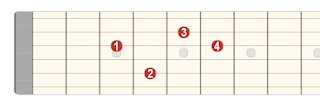
Interval study for fret-hand flexibility (play along the neck)


CONCLUSION:
Okay guys so there’s your 5 guitar exercises for both the picking hand and the fretting hand.

They offer a number of ways to help you improve your coordination, get you better at your dexterity and also help you improve the left and right hand accuracy.

When it comes to playing your music more freely you’ll have done some really excellent work on having a much better sense of balance between the hands. And doing this work will just simply give you better overall strength and performance across everything that you play.


___________________________________________________

GET GOOD NOW - JOIN THE MEMBERS AREA


Join Now

Guitar Chords | F Chord | Guitar Notes | G Chord | C Chord | D Chord | Guitar String Notes

I Did This Blues Lick for 3 Minutes a Day (SEE MY RESULTS!)

If you try studying this lessons Blues lick for just 3 minutes using this excellent playing system I have here in this lesson you'll notice some big improvements take place very quickly!


Performing in position scale patterns as an "exercise" during your guitar practice time won't likely bring you the melodic soloing results that you're after.

Now, don’t get me wrong, I actually like practicing scales within a 4-5 fret range across all six strings. It is really excellent practice when it comes to building the scale patterns (especially when the goal is exclusively scale memorization).

The problem with only doing scale practice is that the focus can be misdirected as it often times gets put upon the scale pattern itself and not on the quality of the way the scale can be used to create melody lines.


Today we’re going to take a small section of a 4th-string root Blues scale pattern and we’re going to memorize it. Then, we’ll organize a Blues lick from out of it’s notes. And then, we’re going to expand upon that blues lick. But, the best part is I’ll show you how to do all of this within three minutes...


After that, we’ll run through a short-list of all of the “Excellent Playing” benefits that can come out of the result of doing this short /simple scale exercise - on a daily basis …So, let’s get right into the first idea to start with here – it’s a small section of a 4th-string root Blues scale in the key of “A.”


Example 1).
Blues Scale Pattern (4th string /seventh fret)


Example 2).
Basic guitar lick from the pattern


                         ____________________________________________________

I wanted to take a minute to let you know, that if you want to learn even more about scales and theory I have a great offer for you.

With any donation over $5, or any merchandise purchase from either my Tee-Spring, or my Zazzle store, I’ll send you a free copy of THREE of my most popular digital handouts.

One is called, “Harmonized Arpeggio Drills” (it’ll train you on developing your diatonic arpeggios).

Another one is my “Barre Chord” Handout which includes a page showing all the key signatures along with a chord progression that applies barre chords.

Plus, you’ll get my Notation Pack! It has 8 pages of important guitar worksheets for notating anything related to; music charts, guitar chord diagrams, and TAB.

As a BONUS, (from my "Over 40 and Still Can't Play a Scale" video), I'll also throw in a breakdown of all of the chords that are diatonic to the "F Major" scale.

As an EXTRA BONUS for my Phrygian Dominant video, I'll also throw in a breakdown featuring all of the chords that are diatonic to the Phrygian Dominant scale.

Just send me an email off of the contact page of CreativeGuitarStudio.com to let me know about either your donation or your Merchandise purchase and I’ll email you those digital handouts within 24 hrs.    

                       ____________________________________________________


Example 3).
Supplemental (expansion) of the lick


Exercise 4).
Taking the idea one step further


Click on the above image to view full-screen


BEYOND THE PATTERN:
The main thing to understand about what we’ve just done here is that when most guitar students learn a scale pattern they generally learn larger scale shapes that tend to cover the entire group of all six strings, (within a 4 to 5 fret range), on the guitar fingerboard.

After that, students often will become fixated on the scale layout as a fretting pattern only. In other words, they stop there without moving onto the next stage which is all about using the scale shape for creating melodic ideas.

This is the missing link and as you just noticed it doesn’t take very long to do. Within 3 minutes you can go from scale pattern to melodic phrase and even expand that phrase further, eventually reaching excellent skill levels with the scale.


CONCLUSION:
One of the things related to scale knowledge that I encounter a lot as a guitar instructor is that I’ll have a new student attend classes (with me here in the studio), and I’ll ask them – usually on their first lesson with me - “Do you know any scales?

Quite often the most common answer is, “Well, I used to know my scales, but I forgot them all.” The reason why is pretty much always the same.

It is generally because they never had the value stressed upon them of immediately moving the scale tones from being a geometrical pattern on the neck to being used musically, to create licks. If that did not happen, then there’s not much doubt of why the scale was forgotten.

When you learn a new scale map out the scale into manageable patterns on the neck and then study how you can use that scale shape to create melodies.

I promise that if you do that, you’ll not only get a collection of excellent guitar licks under your finger-tips, but you will NEVER forget the scale pattern on the guitar fingerboard!

___________________________________________________

GET GOOD NOW - JOIN THE MEMBERS AREA


Join Now

Guitar Chords | F Chord | Guitar Notes | G Chord | C Chord | D Chord | Guitar String Notes

LEARN 9 Strum Patterns - Cover 1000's of Songs!

If you want to get good at playing rhythm guitar (and do it fast), but you think it’s impossible because you don't know any strumming patterns, then you are definitely going to want to watch this video.

Whether you are a beginner, or you currently already have a few strum patterns down, it doesn’t mean that you have to compromise on your ability for knowing a collection of the most important strumming patterns in music.


The key to building strength and getting stronger on; rhythm duration, strum patterns, strum dynamics and stylistic grooves is understanding that you are only as strong as your weakest rhythmic skill.

The 9 strum patterns in this lesson actually give you a chance to work on the weak links in your rhythm guitar skill set to become even better at rhythm guitar than you can from simply learning how to strum your way through random songs.


In this post I’m going to show you NINE strum patterns – that are so versatile - once they're developed they will be able to help you to play rhythm guitar parts for THOUSANDS of songs.

We’re going to cover strum patterns that work well in many different music styles like; rock, rhythm and blues, pop music, soul music, Folk, bluegrass, country, funk, smooth jazz, and traditional blues and many others.

You see, by learning this collection of NINE strum patterns, you’ll have the ability to set the stage for music in all of those styles I just mentioned.


These nine strum patterns are the smaller rhythm strumming patterns that can be learned and then modified as you see fit to work excellent when it comes to performing Rhythm Guitar in all of those music styles!

So, let’s dig into this and get started with learning these NINE strum patterns for becoming a more versatile rhythm guitarist…


Our first chord in play will be "G Major"


Pattern 1).
Pop, Rock, Country (slow for Folk, speed up for Bluegrass)

Pattern 2).
SuperTramp, Led Zepplin


Pattern 3).
Eagles, Garth Brookes, Willie Nelson


Our next chord in play will be "D Major"


Pattern 4).
Soul, i.e., Al Green, Sam and Dave, Marvin Gaye

                         ____________________________________________________

I wanted to take a minute to let you know, that if you want to learn even more about scales and theory I have a great offer for you.

With any donation over $5, or any merchandise purchase from either my Tee-Spring, or my Zazzle store, I’ll send you a free copy of THREE of my most popular digital handouts.

One is called, “Harmonized Arpeggio Drills” (it’ll train you on developing your diatonic arpeggios).

Another one is my “Barre Chord” Handout which includes a page showing all the key signatures along with a chord progression that applies barre chords.

Plus, you’ll get my Notation Pack! It has 8 pages of important guitar worksheets for notating anything related to; music charts, guitar chord diagrams, and TAB.

As a BONUS, (from my "Over 40 and Still Can't Play a Scale" video), I'll also throw in a breakdown of all of the chords that are diatonic to the "F Major" scale.

As an EXTRA BONUS for my Phrygian Dominant video, I'll also throw in a breakdown featuring all of the chords that are diatonic to the Phrygian Dominant scale.

Just send me an email off of the contact page of CreativeGuitarStudio.com to let me know about either your donation or your Merchandise purchase and I’ll email you those digital handouts within 24 hrs.    

                       ____________________________________________________


Pattern 5).
Smooth-Jazz, Rhythm & Blues (Smokey Robinson, Isaac Hayes)


Pattern 6).
Folk Pop (Neil Young, Pete Seeger, Ron Sexsmith)


The next chord in play will be, "D Dominant 9"


Pattern 7).
Pop Funk, Funk-Soul, (Prince, Curtis Mayfield, Kool and the Gang)


Pattern 8).
Heavy Funk, (James Brown, Rick James, R.H.C.P., Hendrix)


Our last chord for these rhythm exercises will be "A Dominant 7"


Pattern 9).
Traditional Blues (the Shuffle Feel) Buddy Buy, Muddy Waters, Robert Cray, Albert King, Rolling Stones


CONCLUSION:
Let’s face it guys having these 9 rhythm strum patterns as your foundation offers you the variety with rhythm strumming that can be used as your rhythmic base to strum; eighth-notes, sixteenth-notes, syncopated ideas and triplet rhythms across all of the most popular styles of music.

Whether you’re trying to get better at strumming along to a song, or you’re just trying to compose your own original rhythm strumming part for something that you’re writing - the fact is - these 9 patterns can offer you the framework to build a stable foundation for rhythm strumming that will give you a lot more skill when playing rhythm guitar.

And, these patterns also offer the opportunity to become more versatile! So that means, no more excuses when you’re called upon to strum guitar in a new style of music.

___________________________________________________

GET GOOD NOW - JOIN THE MEMBERS AREA


Join Now

Guitar Chords | F Chord | Guitar Notes | G Chord | C Chord | D Chord | Guitar String Notes