Posted by Andrew Wasson
Wednesday, August 14, 2019
Are you after instant gains over your guitar neck and scales but you have tried every scale exercise without seeing the results that you have been aiming for? Then you need to watch this video...
In this lesson, I’m going to show you the best ideas for improving lateral movement along the neck. In fact, when you see and feel how to perform these ideas, you’re going to start getting much longer and flowing guitar lines. This will be extremely helpful, if you've ever felt ineffective when playing further along your neck. After this lesson those days will soon be over. WATCH THE VIDEO:
In this lesson I want to show you guys how to get instant scale gains by moving further unique phrases along your guitar neck. I’ve met so many players over the years who have learned scales in a position, but they still say that they can’t make music with them very easily. While being locked into a position can be good for neck awareness, it isn’t always the best thing for creating music. When it comes to heading further along the neck and making the range of the scale even wider across the span of the fret-board, there are more ways that you can practice.
The process is great because it increases the lateral efficiency of what you’re doing, (while still working with simple enough shapes that they’ll allow you to have an ease of creating melody).
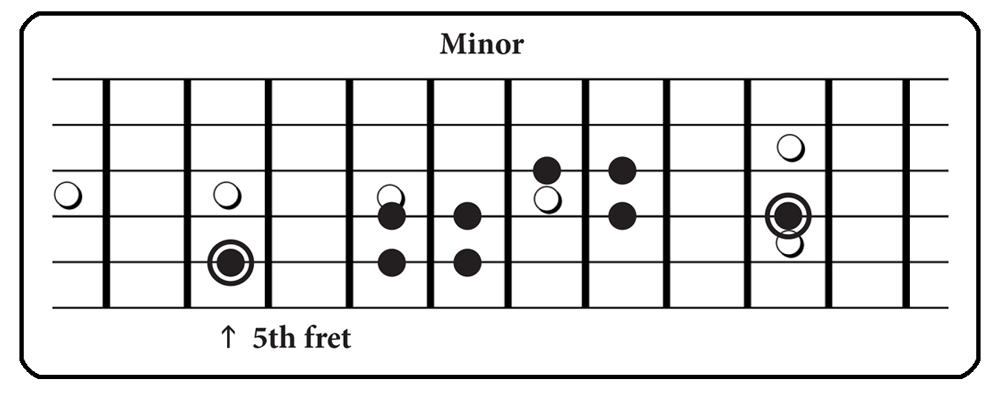
EX. 1 - SCALE GAINS (MINOR): In this lesson, we’re going to begin with a pattern from the Minor scale and I’ll teach you how to start linking the shapes, for helping to move a lot more distance along the neck and establish greater gains along the fret-board for a bigger more melodic sound…
The first pattern that we’re going to run through is based off of the 5th string at the 5th fret. It’s a pattern of a “D Nat. Minor” scale. The shape covers a range of 7 frets between the 5th string to the 3rd string, and it looks like this… Minor Scale Gains Shape:
This pattern offers a very lateral stretched out shape along the neck that uses minimal strings. The fret-span promotes unique fingerings as well as, the use of, slides plus other options for phrasing devices. I wrote a melodic example that you can learn at home from this neck pattern. It demonstrates the phrasing options that can come from applying this type of an approach. Minor Melodic Example:
APPLICATION: Putting this Minor shape to use over a Jamtrack and working toward making up some melodic ideas is going to be the next order of business. So, break out your looper pedal, or visit the web-site “ChordChord.com," and lay down a backing track for practicing this scale pattern in the key of "D Minor." The faster you get to work on creating melody from these shapes - the better. In the video, at [03:55] I demonstrate the use of this pattern over a basic key of “D Minor” Jamtrack.
EX. 2 - SCALE GAINS (MAJOR): With such a large span to these lateral scale ideas they end up offering us a lot of really great ways to play licks and lines that can cover a lot more ground than the basic in position scales. Our next shape will be a Major pattern that covers a very large range across the neck. This pattern spans from the 4th-fret to the 10th and it uses all six guitar strings, built from the notes of the, “D Major” key signature. Major Scale Gains Shape:
As you could tell form this shape (above), and the previous Minor key melody idea (that I played prior), this approach that we’re using here is absolutely great for setting us up with unique sound options from these stretched out patterns and these unorthodox note groupings. In fact, these patterns can almost immediately generate interesting melodic ideas from the very first time they get played.
The other option we have with these shapes is that we can phrase using any note as our focal tone.
Getting Modal: If you enjoy the sound of modal ideas in your guitar playing, modal options (from these scale patterns), is an excellent approach to take under your finger tips. This is especially true if you’re still getting used to using Modes, or even if you’re trying Modes for the first time! So, here’s a guitar lick that uses the key of “D Major” layout we just studied. But, we’re going to resolve into the note of “A” and generate the sound of “A Mixolydian.” Mixolydian Melodic Example:
Well, now it’s that time once again to break out your looper pedal, or visit the web-site “ChordChord.com," and lay down a backing track for practicing this key of “D” scale pattern. In the video, at [07:14] I have some fun off of that Modal root of “A Mixolydian” and I demonstrate the use of this pattern over an “A" Mixolydian Jam-track.
•VISIT THE WEBSITE: If you’d like to learn more about topics like this one and many others,join my members siteas a free member and start looking through my, “Guitar Courses.” I’ve spent over 25 years working with hundreds of guitar students creating thousands of detailed step-by-step guitar lessons for both my website members and my private students. The result is the most comprehensive guitar course that covers every aspect of beginner to advanced playing ideas to help you improve your playing.
•LIMITED TIME OFFER: If youjoin my siteas a Premium member, you’ll receive aFREE copyof my popular Guitar Technique eBook. My Guitar Technique eBook is 28 pages of jam-packed exercises, drills and studies for mastering all of your technical skills at playing Guitar.
Looking for that perfect scale pattern for guitar solos? A pattern that's going to deliver exactly what you'll need for your next major or minor guitar solo? Well, you're in luck! This lesson has a couple of shapes to help you play some great lead and become as effective as you can be...
NOTE: If you want to adopt a more rigorous total guitar solo workout routine, then you will want to pair this up with the Advanced Guitar Program on my website www.CreativeGuitarStudio.com We’re continuing on our guitar neck series today with a lesson covering a few, “Perfect Patterns for Lead Guitar.” It’s hard to declare total perfection from guitar scale patterns because it’s almost impossible to just use a few scales to hit every type of musical situation out there. But, in this lesson I’m going to focus on the most popular sounds and show you some great shapes to start using for making music with. WATCH THE VIDEO:
MAJOR SOUNDS: We’re going to begin with major sounding ideas first and I’ve got a really nice Major shape that I’ve been showing my students here in the studio for years now and I know you’re going to get tons of mileage out of it too. First, let me run through and demonstrate this fret-board scale pattern for you, so that you can start learning it at home. Major Shape:
Blue note is for bends
This sound can work over top of almost any major idea in music and it can even work well over Blues with a slight modification of adding a passing tone at the 10th fret of the 4th string. Blues Modification:
So next, let's run through a short melodic statement that I’ve written for you to try at home. Melodic Example 1).
Next, have some fun using this shape over a jam-track in the key of, “A Major.” Just fool around and work on making up a few melodic ideas.
______________________________________
Practice Tip: Use an 'online chord jams web-app' like, "ChordChord.com" to create fast backing tracks for testing new scales at home... You can learn how to use "ChordChord" in my video lesson on how to, "Master Scales and Melody." There's a great tutorial for you at the [12:05] mark. Experiment with the sound, practice making up phrases that come across as interesting to your ear. And, remember to use phrasing devices like; slides, bends, hammer-on’s, pull-off’s and vibrato to make the music that you play sound more interesting.
______________________________________
MINOR SOUNDS: Now that we’ve worked on Major key sounds, let’s shift over to Minor key ideas and learn how to deal with them. I have another great shape for when you have a Minor key sound that you want to create a few minor guitar melodies over. Minor Shape:
Blue note is for bends.
This scale layout works great over any Minor idea in music and it can also work over Blues with another modification of adding a passing tone (this time at the 8th fret of the 3rd string). Blues Modification:
So next, let's run through a short melodic statement that I’ve written for you to try at home. Melodic Example 2).
Next, have some fun using this shape over a jam-track in the key of, “A
Minor.” Just fool around and work on making up a few melodic ideas. Practice making up a few melodic ideas. All you need to do is experiment with the new Minor
sound, and try to make up phrases that come across as interesting to your
ear. Also, keep in mind about what I’d mentioned before with the use of
phrasing devices like; slides, bends, hammer-on’s, pull-off’s and
vibrato – Those techniques really go a long way in making the music
sound a lot more interesting!
CONCLUSION: Once you get comfortable with these scale patterns, and you can move them to different keys all along and across the neck - you can start to further expand on them by taking them over to different string sets as well. After awhile, you’ll find that they’ll become; better memorized, you’ll be able to phrase with them a lot easier, and it’ll feel more natural to solo with them.
•VISIT THE WEBSITE: If you’d like to learn more about topics like this one and many others,join my members siteas a free member and start looking through my, “Guitar Courses.” I’ve spent over 25 years working with hundreds of guitar students creating thousands of detailed step-by-step guitar lessons for both my website members and my private students. The result is the most comprehensive guitar course that covers every aspect of beginner to advanced playing ideas to help you improve your playing.
•LIMITED TIME OFFER: If youjoin my siteas a Premium member, you’ll receive aFREE copyof my popular Guitar Technique eBook. My Guitar Technique eBook is 28 pages of jam-packed exercises, drills and studies for mastering all of your technical skills at playing Guitar.
Learning how to study guitar properly is one of the most fundamental places to start if you're shooting for higher-level progress with your guitar playing.
Proper guitar study involves; analyzing what you're playing, taking into account all of the notes being played, learning how to judge interval distance and learning how to confirm the scale type. Are you working on this?
Even with all of these tips and cues on how to study guitar properly, some guitarists could still end up skipping these steps. Make sure that isn't you!
This lesson will offer an easy path to understanding these ideas so that you can start experiencing true, "Fretboard Freedom."
WATCH THE VIDEO:
Obviously, learning the guitar neck with an understanding of how each idea that you play relates to Music Theory is important. Knowing this stuff will make you a much better musician.
HOW DOES THIS WORK? Music operates in such a way that, when you play one musical idea it always affects what happens into the next musical idea.
In this lesson I’m going to introduce you to a couple of really great interactive music training web-sites and we’re going to get you learning your fret-board in a whole new way. After we do this, you’ll not only better comprehend every idea that you play from now on – but you’ll also discover how easy it can be to learn the theory behind the music!
Let’s start off by checking out a short melody line on the neck… Melodic Idea:
Something really important that every guitar player needs to understand, is that a melody, (or a chord progression), is a connected idea. It has a starting point and it has an ending point. Those two points anchor the sound, and over 90% of the time, those points are the “root notes of the scale” within how the idea functions musically. Melody Layout on the Neck:
The best way to tie everything together can be done by first checking the notes off of the root, and then using them to find out what scale we’re playing. For most people, this stuff is a total mystery, but it doesn’t have to be like that. Let’s check into how this would work with our melody.
The notes of our melody pattern sits on the neck like this.
ANALYZE EACH NOTE: What's most important here is analyzing the specific notes that get played within our melody. They are “F#, G, B, C, and D.” Now, to pull everything together, we need to focus on the note that starts the melody, as well as the note that ends the melody. The starting note is “G.” And, the ending note is also “G.” So, we have “some type” of “G” scale here. But, we don’t know what kind of “G” scale? Is it Major, or Minor, or some type of mode? DETAILED ANALYSIS: So, this brings us to the best part of the lesson. We’re going to figure out the theory behind our idea, and it’s going to be really easy, because we’ll use a couple of great online interactive music training websites. The first thing we’re going to do is use the Interval Checker (over at “MusicTheory.net”) and check the intervals of our melody. Interval Analysis: Watch the Video
We already know the starting and ending point notes are “G.” But, we just need to figure out what’s going on with the other notes.
Once we've figured out the interval distances between the notes of our melody, we need to make sense out of the scale tones that are missing. Remember to construct a full-scale, we need seven notes. In our example, we only have five. So, we’re missing two. They are an “E” and the note of, “A.” If we were to add those notes in, we’d establish the full span of scale tones from off of our root of “G,” and we’d end up with a completed scale that has the notes of:
“G, A, B, C, D, E, and F#.” The Complete Scale:
Once we have the general note layout of the scale, all we need to do next is use a helpful interactive scale look-up tool that’s located over at, “Chord.rocks” With that, we’ll be able to understand what scale it is specifically that we’re dealing with. Scale Analysis: Watch the Video
As you just noticed, this process is really easy. You can do it with any group of notes from a melody that you’re working on and when you start playing guitar like this, you’ll notice three things:
a lot more freedom to move ideas around on the neck,
make up new related ideas for the music you’re playing
start composing musical parts that fit together fast and easy
THE POWER OF KNOWLEDGE: In our melody, now we know that this idea is based within a Major sound with the root note being “G.” This means we can expand on the melody, using something like the “G” Major Pentatonic scale. We also know that it’s a basic major scale. So, this tells us that our melody is really coming from the key of “G Major.” So, that means, that any chord based out of the key of “G Major” can work to create additional chord patterns. With all this information, we could write a whole song around just one simple riff.
ALTERING NOTES: Let’s alter a note in our melody and run through this method one more time. Here’s our melody played again, but this time with an “F natural” replacing the “F#.” Version (2):
The new fretboard layout:
Analyze the notes:
Next, let’s head over to “MusicTheory.net” and learn more about the new interval on our melody. Interval Analysis: Watch the Video
From the interval study, we know that we still have a major scale sound. But, the root is “G” and the 7th step is minor 7. If we add the missing notes and check the scale over at “Chord.Rocks” we will find out what scale this really is… Scale Analysis: Watch the Video
Now that we’ve organized the intervals, we realize that the notes are all natural based off of the root of (G). When we used the scale finder at “Chord.rocks” we found out that this riff (with the “F natural” tone), is actually the “G Mixolydian” scale. "G" Mixolydian:
"G Mixolydian" is the 5th step mode of the key of “C Major.” This means we can use all the chords and notes of the key of “C Major” to go forward and compose more ideas around this riff.
CONCLUSION: So, in wrapping up, my parting advice is to start using everything I just went over here. Start doing more analysis of what you’re playing. Learn about intervals, keys and scale types. It’s so beneficial. In the beginning it might seem a little over-whelming, but if you stick with it, and push yourself to fill in any of the gaps that exist across your current level of knowledge, you’ll really broaden your horizons. Once you understand all the basics, you’ll start playing guitar like a musician, like a composer, and most importantly, you’ll have a lot more freedom around the guitar fretboard.
•VISIT THE WEBSITE: If you’d like to learn more about topics like this one and many others,join my members siteas a free member and start looking through my, “Guitar Courses.” I’ve spent over 25 years working with hundreds of guitar students creating thousands of detailed step-by-step guitar lessons for both my website members and my private students. The result is the most comprehensive guitar course that covers every aspect of beginner to advanced playing ideas to help you improve your playing.
•LIMITED TIME OFFER: If youjoin my siteas a Premium member, you’ll receive aFREE copyof my popular Guitar Technique eBook. My Guitar Technique eBook is 28 pages of jam-packed exercises, drills and studies for mastering all of your technical skills at playing Guitar.