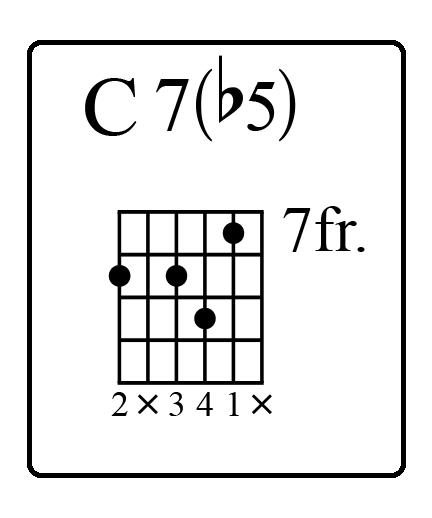
Have you spent any time studying the seventh chord shapes on guitar? These chords are not exclusive to jazz music. The seventh qualities can be found in dozens of varied music styles. In this lesson, I demonstrate the patterns of 10 popular seventh quality chord types. Once you get these patterns down, you'll open up a whole new world of sound into your guitar playing...
Chords are absolutely integral when it comes down to being able to build a solid skill set for playing rhythm guitar. There are a lot of different chords to learn, but far too many players allow chord study to take a back-seat after learning two popular chord categories. The popular categories include; the open position shapes and a few of the movable barre-chord patterns. Don't allow yourself to stop there. Learn as much as you can about the seventh chords. They open up a whole new world of sound. In this video, we’re going to move into the area of 7th chords and study TEN “Different” 7th-chord patterns on the neck.
These shapes are going to be of a great value to your playing ability! Seventh chords are used in all kinds of music styles.Their application is vast, so incredible benefits can come form the study of their layout and application in music. TEN SEVENTH CHORDS: 1). Diminished 7th (also called Fully Diminished)
2). Minor 7(b5) /also called ½ Diminished
3). Minor 7th
4). Dominant 7th (b5) /also Dom. 7 Dim. 5th
5). Dominant 7th (the Dominant Chord)
6). Dominant 7th (#5) / the Dom. 7 augmented 5th
7). Major 7th
8). Minor /Major 7th
9). Major 7th (b5) /the Maj. 7 Diminished 5th
10). Major 7th (#5) / the Maj. 7 augmented 5th
CONCLUSION: Learning how to play interesting chord patterns like these is only the beginning. The real learning comes from the application of these patterns across chord progressions from many different types of music. Luckily, pretty much all of these chords will be found in popular music styles from; Rock songs, and Top 40 music, as well as, Blues, they’re a big part of; Jazz, Country, Soul music, R and B, Hip-Hop, Motown, Classical music… the list is most certainly long of where you’ll find them, because these chords are going to show up in all kinds of places musically. So, learn the patterns, and get used to playing them in songs. And, be sure to compose some of your own original pieces using them as well. Actually, that’s often the best way to commit them to memory. Over time, these chords will get easier to play, and your ability to understand their functionality will get also easier as well.
VISIT THE WEB-SITE: As always, thanks for joining me, if you liked this video, please give it a thumbs up and subscribe for more, (and remember to hit that bell when you subscribe so that you’ll never miss any of my uploads to YouTube)… I also want to let you know about the guitar courses over on my website at CreativeGuitarStudio.com I’ve got step-by-step; Beginner, Intermediate and Advanced courses that work alongside of in-depth elective programs to form the best guitar course available. The courses work to help you learn to identify what's required to get you up to that next level of guitar playing, in a very organized step-by-step way, that makes sense. I look forward to helping you further at CreativeGuitarStudio.com
NEW The 18th lesson of "Rhythm Guitar" shifts to a new practice routine that has the sessions start including composition. Each of the remaining Rhythm Guitar episodes will not only include stylistic examples, but they will also include a section for students to create their own original rhythm jams. A bonus for BASIC and PREMIUM web-site members are the (9) MP3 play-along tracks that will help with learning each rhythm example.
Paid Web-site members (BASIC and PREMIUM), can watch the associated video lessons and download the detailed PDF handout, along with the MP3 clap /strum play-along tracks...
Join the member's areato download the PDF handout and MP3's. Study all of the examples with full access to both video lessons. Be sure to spend some additional time on learning the "Rhythm Jam Challenge" piece that I performed at the start of the lesson in the "Part One" video... EPISODE 18: The lesson plan for episode 18 is focused upon performing rhythms in the Soul /R and B style. Four examples in the lesson will focus on covering; the Slow Soul Guitar-chop, R and B Rhythm-shot (rock steady), Slow Groove Hip-Hop /Soul Fusion, and Funk-Soul Motown (16th-note) groove.
PART ONE (free on YouTube):Example one, explores how to practice the popular "Slow-soul" guitar chop. This steady and balanced groove operates around a single measure rhythm meter. PART TWO:In example two, the groove is based upon tight rhythm shots within the R&B style. This rhythm approach is often called the "Rock Steady" rhythm and can be heard in many songs. One of the legendary players who uses this groove often is guitarist Steve Cropper.
PART THREE:
In example three, the two-measure phrase of this rhythm is wide and open with the primary note duration being that of a whole-note. The whole-note is applied across beats 1, and 3 of measure one and beat 1 of measure two. 8th-notes are applied to the ending of measure two (beats 3 and 4).
PART FOUR:Example four involves the use of another two-bar phrase that centers around the slightly syncopated 16th-note feel. This groove is based on the heavy accent of the beat of, "1."
Posted by Andrew Wasson
Tuesday, November 13, 2018
Ever heard of the Chord Chop? It's a heavy handed way of hitting at the guitar strings where individual sections of a chord are struck. The technique allows for highlighting specific segments of string groups offering greater dynamics and strength to rhythm parts. If you’ve never experimented with this technique, you’re long overdue.
The chord chop technique is a way of playing rhythm where you hit a chord forcefully on either the back-beat, (it can also be muted and marked rhythmically on the off-beats, or also upbeats). Rhythm players need to learn this technique, because it’s a way to split apart the tones of a chord allowing us to add other intervals around the rhythm that will work nicely to highlight different parts of the groove. Chord chop technique is also often played using select ghost hits, (a chord hit that’s played muted by lifting up the fretting-hand fingers immediately after strumming the chord). The ghosted chord chop along with the normal chord chop gives us a percussive sound that works great in styles like: R and B, Motown, Blues, Soul Music, Hip-Hop and Smooth Jazz. WATCH THE VIDEO:
CHORD CHOP EXAMPLES: Riff #1). Here’s a Chord Chop idea with accents on the up-beat of the count of the beat of, “3”
Riff #2). Here’s another Chord Chop riff that accents on the ‘up-beat of 3’ (in measure one), and on the ‘up-beat of 2’ (in measure two)
Riff #3). Here’s a chord chop guitar part that’s playing the “ghost” technique on each measure at the “up-beats of 2.”
THE "CHOP" TECHNIQUE: As you can tell, the "chord chop" can occur in several ways, but it usually consists of a downward strum on the up-beat notes. And, (as you noticed in our examples), alternatively there can be bass-notes played and allowed to ring-out underneath. There can even be chords that are chopped on the up-beat. The thing is that this technique is most commonly used in a rhythmically simple manner, as simple as just chopping on every beat, or on down beats and ghosting on the up beats. Guitarists like; Freddie Green, Steve Cropper and Django Reinhardt are a few of the players that are well known for applying this technique throughout their rhythm playing.
CHORD CHOPS AND RHYTHM: The secret to playing great sounding guitar-chop rhythm parts has a lot to do with paying attention to the rhythmic flow of the music. Most songs will consist of fairly simple melodies and only a limited collection of chords, so the groove has to be strong and that’s where chord chops can really come in handy. It’s important to also understand that the role of most rhythm guitar players is to work with the drums and bass to keep the song grooving.
CONCLUSION: You'll have an easier time nailing the songs feel when you learn to break apart the chords using this Guitar Chop technique. Just focus on locking down on the groove with your strum-hand, and keep targeting notes through the chord patterns. It’s a little different than the strumming style that’s done in Folk or Campfire songs, but once you practice this a little while, you’ll train your pick-hand to have a lot more accuracy and skill for the, “Chord Chop” approach.
VISIT THE WEB-SITE: Be sure to carry on and look into all of the exceptional online guitar courses I have over on my website at CreativeGuitarStudio.com. I’ve got step-by-step; Beginner, Intermediate and Advanced courses that work alongside of in-depth elective programs to form the best guitar courses available. My courses work fantastic to help you learn to identify what's required to get you up to that next level of guitar playing, in a very organized step-by-step way, that totally makes sense. I look forward to helping you further at my website; CreativeGuitarStudio.com As always, thanks for joining me, if you liked this lesson, please
give it a thumbs up and subscribe for more on YouTube, (and remember to
hit that bell when you subscribe so that you’ll never miss any of my
lesson uploads to YouTube)… Until next time, take care and we'll catch up again on the next lesson. Bye for now!
NEW This unique Creative Guitar Studio course explores exercises for increasing dexterity and coordination between the hands. The goal of the course is to increase awareness, mobility and control.
Lesson 017 of Guitar Technique works through a series of drills that incorporate two popular picking concepts. These are the techniques of "sweep picking," and "rake picking.".
While these two terms are often used interchangeably they can be thought of as two separate techniques. The "rake" is most commonly associated with a down-ward pick movement across the notes of a chord. And, the "sweep" is most often associated with movement both down and up across the tones of an arpeggio.
Both Rake and Sweep pick techniques produce a very similar sound in where the individual notes are performed in a very rapid manner. When performing these ideas it is important to train the fretting hand to lift each finger off of each tone so that the notes do not end up ringing out against each other, (like a chord strum).
Parts one and two of the lesson will focus on hand management and string groups. Part three and four of the lesson will expand to include melodic applications of each technique.
Paying members of the Creative Guitar website can watch both video lessons and download the PDF handout...
Join the member's area to download the PDF handout and start study of these exercises. Study all of the examples with full access to both video lessons...
Ever wonder how certain guitar players seem to so easily take liberties with notes, playing notes that don't even belong in the key... How can guitar players do that? How come some players end up using notes that don’t belong? And, how can playing those “wrong-notes” work to create more unique riffs and melodic lines?
Find out in this episode of, "The Guitar Blog Insider."
WRONG NOTES: Wrong notes can be found in; Jazz, in Country and in Blues, they're used a lot. The problem is - the first times that we ever try to use these wrong notes, they sound really off kilter. When playing and practicing the use of wrong notes, we need to not only train ourselves for which notes are the unique “wrong” ones, but we also need to learn how to get used to hearing the application of them. Once we can properly manipulate wrong intervals and get them into the kinds of music that we want to use them in, we'll achieve better control over these tones.
This control is the secret that all of the guitarists who use this approach have developed when it comes to playing wrong notes. WATCH THE VIDEO:
WRONG-NOTE SKILL BUILDING: I’m sure that you’ve quite likely heard of scales such as the Mixolydian and the Blues Scale, or even the Arabian or the Egyptian scale. Perhaps you’ve heard of other specialty or exotic scales as well. The names won’t really mean that much (until you begin an in-depth study), but there is one thing that all of these scales do have in common. A scale that you do not comprehend needs to be well developed 'before' you can use the scale effectively.
This means that you’ll need to get used to the new tones, (including how they sit on the guitar fingerboard, and what each scale tone sounds like when it gets applied across a musical phrase).
THE COMPOSITE BLUES SCALE: In order to help you begin experimenting with this concept of wrong notes, I have a great way to help get you started.
We'll roll this out by performing some phrases that use a popular 'blended note' layout of the Major and Minor, Pentatonic Scales, called the Composite Blues Scale…
The "Composite Blues" is a scale that you could say is pretty much FULL of wrong notes. It doesn’t fit in very well against straight Major Keys or straight Minor keys.
However, this scale does offer some fairly unique options and a number of, “off-the-cuff,” note opportunities. The way this scale is structured allows us to add a number of interesting scale tones around our licks and riffs. First, let’s learn what the notes are that are specific to the set-up of this scale...
Now, lets have a look at how one possible pattern for this scale can sit upon the guitar neck from the root of "C."
BLENDED INTERVALS: The “Composite Blues” scale overlays a blend of both major and minor intervals that include the major and minor 3rd, the (aug. 4th) or diminished 5th and a Minor 7th. This scales collection of tones creates a unique sound which can be great for playing over; rock, blues, country music, soul, /R-B and jazz (it’s quite versatile). The “Composite Blues” scale includes nine separate notes (with the 10th being the octave). It blends major and minor intervals together to form a highly unique soundscape. The scale itself offers us a fingerboard pattern with a wide range of different sounds for guitar players who wish to inject more “off the wall” tonal effects into their music. Learn the 3 musical examples that I've created below. They will help you to begin understanding how to add the series of 'wrong notes' found in the Composite Blues Scale…
Example #1). Blues Lick
Example #2). Country Riff
Example #3). Prog. Rock Groove
CONCLUSION: In wrapping up, the main thing I would like to stress - as you go forward with this idea - is that this type of sound (this effect of using wrong notes), is really unique and it has a ton of musical possibilities within many different kinds of music. So, practice the ways that the outside scale tones, (like the Major and Minor 3rds and the Minor 7th and that diminished interval), might be able to be applied and also be sure to test out all kinds of styles and sounds using this approach. Over time, you’ll start inventing a bunch of different ways to get going on using this sound, and you’ll start to realize that even, “Wrong Notes,” really can sound Great!
As always, thanks for joining me, if you liked this lesson, please give it a thumbs up on YouTube and subscribe for more, (remember to hit that bell when you subscribe so that you’ll never miss any of my uploads to YouTube)…
VISIT THE WEB-SITE: I wanted to let you know about the guitar courses over on my website at CreativeGuitarStudio.com I’ve got step-by-step; Beginner, Intermediate and Advanced courses that work alongside of in-depth elective programs to form the best guitar course available. The courses work to help you learn to identify what's required to get you up to that next level of guitar playing, in a very organized step-by-step way, that makes sense. I look forward to helping you further at CreativeGuitarStudio.com Until next time, take care and we'll catch up again on the next video. Bye for now!