Mark Knopfler's guitar playing is legendary in the music community and that makes him a guitarist worth studying. At some point every practicing guitar player will end up taking a closer look at the way he both plays and how he composes.
That is exactly why we're going to check out the style of Mark Knopfler on this weeks "Guitar Blog Insider"...
Knopfler tends to hold back more than shred and he doesn't set out to show off his "chops" in the way that many other famous guitarists do. He plays guitar in a way that fully supports his songs. Whether that involves killer solos performed with just the right notes played on every chord, or even when he is simply playing a basic rhythm strumming pattern.
THE KNOPFLER SOUND: Picking Technique: To achieve the "Mark Knopfler" tone it will take some practice. His technique is based around the use of his fingers, (he doesn't use a pick). Most of this plucking style is also quite unorthodox. However, it can be developed by focusing on the way he applies the plucking technique of his right hand's thumb, index and middle fingers. Some occasional use of the ring finger is also a part of the technique. Vibrato: Mark uses a unique vibrato and lot's of it - almost anywhere and everywhere he can. So, in practicing playing his style, be sure to work on adding smooth vibrato on everything, (that even includes chords). Guitars and Tone: Knopfler has dialed in on a guitar tone that can be established by using the combined bridge and middle pickups on a Strat (or similar style guitar). Clean tone favors some chorus and reverb and his dirty tone operates with only a touch of tube overdrive. In Mark's early Dire Straits era, he'd rarely be seen playing anything other than a Fender Stratocaster. His fame and success has since allowed him to have ownership over a vast collection of amazing guitars including the incredible Pensa Suhr line of guitars. When it comes to acoustic guitars, Mark is a die-hard Martin acoustic player with his signature Martin-40S model being his primary "go to" acoustic over the years.
Knopfler with one of his Fender Stratocaster's
Knopfler playing the Suhr MK-1
Performing on the Martin 40S acoustic
Amplifiers: Over the years Knopfler has used many different amplifiers. In his early days he favored the Fender Vibrolux and the Twin-Reverb. He also used the Music Man HD-130 for awhile and used Mesa-Boogie heads with Marshell 4x12's. Soldano SLO-100 became his main amp into the 1990's and beyond (keeping the Marshall 4 x 12" cabinets with Electro Voice speakers as his main speaker cabs).
Soldano SLO-100 with Marshall 4x12 cabinets
MARK KNOPFLER HARMONIES: Mark Knopfler's ability to create simple but strong sounding chord progressions has become a staple part of his guitar sound over the years. When composing chord changes he principally favors chords that operate within the diatonic key center. Chords that target resolutions by way of the V or the IV are most common in his music. Work through the Minor key chord changes in example one and notice how the IV-chord in this "A Minor" progression pulls us back to the top of the changes. Example 1). "I-VII-VI-IV" progression in the key of "A Minor"
In many of his songs he places the majority of his focus on the lyrics and the groove, and enjoys the simplicity of basic I-IV-V changes, like in his piece "Cannibals." The up-tempo hill-billy beat of this song (combined with the application of a common I-IV-V in the key of "E Major"), makes it easy to zero in on the lyrics and message of the song. Other songs will take on more of a smooth sound, with an almost "pop-jazz" approach using collections of seventh quality chords in more the style of jazz harmony. This is evident in his piece "Hard Shoulder." In this song, the feel is very laid back in an adult contemporary style. We find him using primarily major and minor 7th chords to create a very smooth effect. Play through the chord changes in example two to get an idea of how this seventh chord approach affects the overall sound of the chord harmony. Example 2). Key of "G Major" progression using seventh-chord harmony
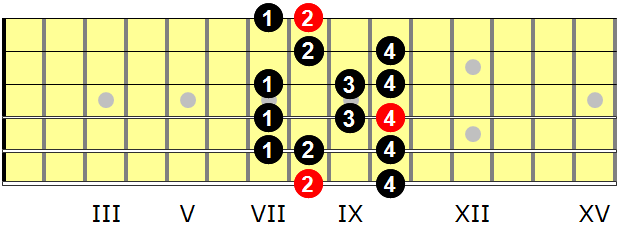
SCALES: There's no questioning that Mark Knopfler has excellent control over his feel of both major and minor key centers. While a majority of his single-note guitar playing places the focus around pentatonic scales, he will also tend to add select tones from the; Dorian, Mixolydian and the Harmonic Minor when he sees it appropriate. His ability to focus on the specific chord tones from pentatonic scales for the melodic connection to each chord is amazing. Add it is also very cool how he outlines chords with arpeggio tones from the chord shapes. Plus, he's very smooth with adding a few extra unique modal ideas around the lines as well. All of this comes together in creating what we all know (and recognize) as his unique melodic sound. His application of different melodic lines and scale runs is done using select pieces of the scale patterns located in mostly in position block areas along the fingerboard. Study the melodic segment below in example one. Take notice of how the scales are located within the 12th position area of the guitar neck. Example #1). 12th Position "A Minor" Pentatonic phrase
In example two, I've set up a classic Knopfler style Pentatonic run located in the 5th position. Plus, I've also added in his staple sound of outlining chords using small arpeggio clusters taken directly from the chord voicings. Example #2). Classic "Knopfler style" Pentatonic lick with arpeggio outlines.
A Mark Knopfler lesson wouldn't be complete without mentioning his abundant application of small chord shapes. This "small chord" performance approach makes even more of an impact when done using the finger-picked technique. Study example three below. I've produced a riff to practice that is largely based upon the sound and style of his guitar part made famous in the hit song, "Money for Nothing." Example #3). Double-stop chord riff (key of "G Minor")
Watch the Video lesson:
CONCLUSION: While Mark Knopfler may not be known in the guitar community for blinding shred tactics or insane use of technical wizardry across the neck, there his no denying that his music is full of very tasty guitar licks. I don't believe anyone would ever say that he is a slouch on the guitar. His technique is there. The feel and connection within all of his songs is always there. And, I think that the reason he is often under-rated in the guitar world (of virtuoso shredders and all that) is because he uses his licks sparingly. Mark Knopfler is all about getting each of his notes in just the right place. In other words, he plays the right notes at the right time, designed add to the music, rather than call attention to him ever wanting to be any kind of a guitar hero.
Songs like "Sultans of Swing," "Money for Nothing," and "Brothers in Arms," are some of his most well known pieces. And, those songs rank as favorite study pieces for many practicing guitar players. But, he has many other songs as well. And, the more you dig into his style, the more you're going to discover just how versatile he really is. So, in wrapping up, it's important to note that while Mark Knopfler may not rip the neck up with shedding madness, (like Malmsteen, Van Halen, Steve vai or Paul Gilbert), what he does do is play into the heart of his songs, and he does that extremely well.
Resolving chord progressions with strength is how musicians use musical intervals to help phrases lead songs back to their tonic chord. It can be applied to any chord progression. And, once a musician understands this important movement, they can use it to their full advantage...
THE LEADING TONE: If you don’t already know, the 7th degree is referred to in harmony as the Leading Note because it leads back to the tonic.
The leading note is a half
step away from the tonic. When strong chord movements resolve, they will use half steps.
SINGLE NOTES Vs. CHORDS: In single note applications it is easy to understand the half-step theory because you only have to think about playing from
one note back to the tonic. When you play with chord resolutions it gets a bit more complex since multiple tones will be aligning around the chords.
Single leading Tone:
Chord Resolutions:
DEVELOPING RESOLUTIONS: Whenever a chord progression is being played or composed, we are searching for interesting ways to resolve back to the tonic. Not every chord resolves directly to the tonic, (V-I), sometimes they will resolve indirectly, (IV-I). Chords that Resolve Directly to the Tonic The chord that resolves to the tonic the best is formed from the 5th (V) degree of the scale, (the Dominant Degree). The reason that this chord is the strongest is because it contains the leading note (7th degree). This "pulls" the sound back "home" to the Tonic chord. In the Key of C, "B" is the leading tone because it is the note just before the Tonic of "C." Study the chart below...
The Dominant Chords formed from the 5th degree resolve better than the basic major chord because the b7 note is added in the dominant chord. This lowered 7th tone resolves to the third of the tonic (in this case E), and the B is also still a part of the chord awaiting its resolve to the C. Look at the chart below to see the notes resolve in a key of "C" (II-V-I) resolution:
Because the V chord resolves so nicely to the tonic (I chord), many songs end with this progression because it is such a strong ending for songs. The diminished 7th chord also resolves nicely to the tonic because it is formed from the leading note (B). In the key of C, a diminished 7 can be built upon the "B" creating a, "B diminished 7" chord which contains the notes B, D, F, Ab. This resolves nicely to the tonic because the B resolves to the C (and Bb if you are playing a C7), the F resolves to the E, and the Ab resolves to the G. Look at the chart below...
Chord resolutions are one of the most important areas of song writing and composing. Once you understand the movements, you'll achieve incredible results. Study the intervals and get to know how chords can resolve. There are options and there are various chord voicings. The way the chord is voiced on the neck will also play a role. So with the rhythm of the piece. Have fun, experiment and create. Over time you'll discover your own favorite chord movements and your favorite resolutions.
The latest QwikLicks video, Octave Displacement Licks in "C Major" is available in the FREE members area. Includes PDF handout!
QwikLicks are a FREE lesson series for all membership levels at Creative Guitar Studio.com. Lessons in the QwikLicks Series run through a short collection of guitar licks covering all types of playing styles, famous artist's playing styles and guitar techniques...
Episode #028 covers three "C" Major licks.
In lick one a displaced "C Major" scale run is split between the string sets covering a 2-position phrase. Plenty of string skipping ideas will help players nail their string crossing ability.
Lick two applies an octave displacement run over a theme connected to the chords of "C, G, Am and F."
Lick three octave displaces a scale sequencing run across multiple positions in a lateral phrase played over four chords.
Transcribing a song by ear can seem like an overwhelming task at first. Most guitarists do not approach it systematically. Often, guitarists will pick a random riff or lick in a song and just try to learn it.
However, taking a more structured approach will make the whole process far easier...
GETTING STARTED: Find a comfortable, well lit, quiet place to work. Have headphones on to hear the sound without any outside distractions. And, make sure your guitar is 100% in tune.
TOOLS: There really isn’t all that much you need to transcribe a song, apart from your ears.
The song in a HQ format is usually the best choice to transcribe from. You will need a good media player that lets you jump to any part of the song you want. There are also specialist song transcription programs which can be a better choice. Most of the tools are not really necessary unless you are transcribing a song with 10+ simultaneous tracks, but other features (like being able to bookmark parts of the track) can be quite convenient and speed the transcription process along.
Transcribe! is one of the better programs for this. It is relatively inexpensive, has all the basic features you need and a convenient layout for accessing those features.
Audacity is probably the best free choice. It is not specifically a transcription program, but you can bookmark sections of the track and change the tempo without changing pitch. The layout is a bit less convenient, since it is actually designed for recording and editing, rather than transcription.
FIGURE OUT THE KEY: The key helps you determine which notes are most likely to be played. It also helps you determine which chords are in the song’s key. Most musicians neglect to actually get the key of the song before transcribing it. Knowing the key of a song can make all the other parts easier to transcribe. Here’s a simple method for finding the key: - Listen to the bass tones. Follow them and test major and minor chords over them. - When you figure you've discovered the key, play every note of the key's scale over the song until you find the notes that fit the best over the top of the track. This will more than likely be the key of the song. There are alternative methods – for example, to recognize the basis of a particular guitar riff without being able to recognize the specific notes instantly, and use that to figure out the key directly since in most cases a prominent guitar riff will be in the same key as the song. Whichever method you prefer for finding the key of a song, make sure you figure it out. Knowing the key will make everything else that follows much easier.
UNDERSTANDING GUITAR SOLOS: The lead instruments are generally the most time-consuming part of transcribing a song. At this point, you should have the rhythm sections and the knowledge of the key completed, (which will make it much easier to begin putting the lead parts in the correct places). Song melodies are not random! As you develop your ear training, it should become easier to recognize specific musical constructs. Most of the transcribing of these parts involves the recognition of the key of the song and what is musically occurring. This will get easier with practice, as you learn to recognize more and more of the common song constructs. If you have extreme amounts of trouble with a song, there are programs that can slow down the song to make it easier to transcribe each note one at a time. RiffStation is a great option for slowing down songs.
SELECTING A 1st SONG TO TRANSCRIBE: It may seem like trying to pick an easy song and build your way up would be a good way to build your transcription abilities. However this is not a very practical method because it is difficult to distinguish what is actually an easy or a difficult song. Most of the difficulty of transcription is distinguishing the subtle nuances that alter pitch.
For example, being able to differentiate between a straight legato, hammer-on, bend or slide during a lead guitar note transition. All of those techniques can be used to go from one note to the next, but each changes the transition sound very slightly. This aspect of transcription is never going away, (no matter how easy the song sounds).
Occasionally, more virtuosic, (difficult to play parts) can actually be easier to transcribe accurately. For example, there are typically only one or two ways to play a 200 BPM passage of sixteenth notes, but a dozen effective techniques for playing 120 BPM passages of eighth notes.
SIMPLE Vs. COMPLEX: Even taking a seemingly simple song, like Joan Jett and the Blackheart’s version of “I Love Rock ‘n’ Roll,” there are still technical nuances to take into consideration. Joan Jett’s guitar part is fairly simple, and usually the one most people imitate. Ricky Byrd’s guitar part, on the other hand, has a decent amount of technical nuance given how simple the song is. Even on a simple song like that, most people trying to transcribe it are going to miss those nuances in favor of a more simple, less accurate version.
Another good example is the riff from “Smoke on the Water” by Deep Purple. It is considered one of the simplest rock riffs by many guitarists, yet virtually no one, outside Ritchie Blackmore, actually can play the technical nuances correctly. That is because the main riff is very specifically played without the pick, which gives those chords a slightly different tone. This is more difficult to notice because you very specifically need the pick for other parts of the song.
Getting the right notes, chords and rhythm for virtually any song is pretty easy. Getting the technical nuances, no matter how easy the song might seem, is where practice and experience come into play. Try to get the basics of the song when you are starting out. As you get better at transcription, go back to songs you have already transcribed and try to get the technical aspects of the song down perfectly. This is a much better approach than trying to arbitrarily determine if a song sounds easy or not.
Guitar players who want to play solos need to learn several ways to play scales over chord progressions.
Knowing the key and the chord relationships are critical for achieving success. The trick is to understand how to use several methods of key and chord relationships to select scales that will work the best when soloing...
Soloing Over a Key: Soloing by "Key" is the easiest method of soloing because you treat the entire song as one key center. This is done by selecting the scale that fits with the entire key and then only play the notes of the associated scale. Associated Keys and Scales:
Scales use the notes of the key signature and the chords are constructed from also using those same notes. For example, the "C Major scale" can be used to build all of the chords found in the key of "C Major."
Major Scales: C Major scale and Chords for the key of C Major:
Minor Scales: If we begin a Major scale off of the 6th degree, we create the "Relative Minor." In the key of "C Major" the 6th note is "A." Therefore, the "A Minor" scale is equivalent to the "C Major." A Minor Chords for the key of A Minor:
Ami, B dim, C, Dm, Em, F, G
PENTATONIC: You can substitute the major or minor pentatonic scale for the major or minor 7-tone scale because all its notes are part of the same key. 8th Position "C Major" Pentatonic:
Now that you have your scales, you can play any note in that scale and it should sound good over any progression that is in the same key. The easiest way to do this is by using a known scale pattern. If you don’t know your scale patterns, use the pattern of the 8th position "C Major" scales shown above.
Soloing Better:
End your phrases on the root note at first. It will reinforce the key. Listen for the notes that sound best over each chord.Search for the best notes. Change positions when you play so you play low notes and high notes. Use dynamics by varying the volume of your playing. Use bends, slides, and vibrato to enhance your solos. Soloing by key works well for beginners, but you will eventually want to use more sophisticated ideas. That is why it is also good to study soloing by chord.
Soloing Over a Chord Keys rarely change within a song, but chords change often. The most interesting soloists change their soloing strategy based on the chord rather than the key.
Pentatonic Scales Targeting into Chords: It is hard to go wrong with Pentatonic Scales. They limit themselves to 5 notes that work well over many different chords. The rule is to use Major pentatonic scales over major chords and minor pentatonic scales over minor chords. This works well for most chords. All you need to do is switch scales with the chord changes. For example, if the progression was Dm7 – G7 – Cmaj7, you could play D minor pentatonic, G major pentatonic, C major pentatonic. You just need to shift the scale and play any note in the scale.
Because pentatonic scales only have five notes, they can start to sound boring and repetitive. That is why we use other scales and the modes.
Major Scale and Minor Scale Similar to soloing over a key, you can use the major and minor scales to solo over chords. The major scale can be used over major chords, and the minor scale can be used over minor chords. Both scales, however are considered modes using the names, Ionian and Aeolian respectively.
Modes
Modes are made for soloing over chords. Each mode is able to play over a specific set of chords. If the chord is dominant, like a G7 or G9, you’d want to play the Mixolydian mode. If it is a minor chord, you can play the dorian, phrygian, or aeolian mode. As the chords get more complex, the mode choices go down. Use the chart below to select the best mode for each chord.
I
Major
Ionian (Major Scale)
Major, Major 7
II
Minor
Dorian
Minor, Minor 7
III
Minor
Phrygian
Minor, Minor 7
IV
Major
Lydian
Major, Major 7
V
Major
Mixolydian
Major, Dominant 7, Dominant 9
VI
Minor
Aeolian (Natural Minor Scale)
Minor, Minor 7
VII
Minor
Locrian
Diminished, Minor 7b5
Chord Tones
Some guitarists solo using chord tones. As the chord changes, you change the notes that you play. Arpeggio patterns are a great way to learn the chord tones.
Approach to Using Scales Once you have a scale, mode, or chord arpeggio to use, there are a lot of techniques that you could start to apply. Emphasize the root note of the current chord. For modes, try playing every other note. This can work well to map out the chord tones. Try to use voice leading into upcoming chords. Before the next chord arrives, play a note that is a half step or a whole step away from the next chord’s root. This will help lead into the next chord. It takes some practice to master, but it sounds excellent.
What’s Next?
Soloing is mostly about knowing what notes to play. And, a lot of it is done through instinct. We can simplify the process by using full scales, pentatonics, and modes. But the best thing to do is to use backing track chord progressions and start practicing your improvisation with Jamtracks.
While most of us would love to play guitar every day, the reality is that there are so many other things on our daily to do list, we sometimes end up pushing away our time to practice until the day is over and then we often (unfortunately) don't practice at all...
What it can take is making that first step. Maybe it's that first week of a practice schedule change that snowballs into a month, and then into a year of incredible practice. You'll never know until you try this approach and start to experience the results that work best for you.
Once you start to notice the effects of these study changes, I think you'll become hooked on them and your new weekly practice routine will begin to evolve right along with your guitar skills.