Being a musician isn't easy, and the life-style can really take its toll, all things considered, how do you manage to stay positive in such a crazy business? The spectrum of potential difficulties and hardships you'll face as an independent musician are vast, from physically grueling tours to financial struggles to the ever-looming fear that your career may be going nowhere. And, let's not forget that all your feels are on display to either be loved or ripped apart by an audience every time you play (or anytime they listen to your recordings). All things considered, how do you manage to stay positive?
Happiness, in a way, is made of good habits. You can guide yourself toward contentment: Avoid certain negative behaviors that contribute to chronic unhappiness, and adopt those that promote positive feelings. If you're looking for a change in your outlook, here are seven ways to help you get started.
1. Take care of yourself
You know this already: you'll feel better overall if you eat well, exercise, get good sleep, and don't binge on alcohol or drugs. You don't have to go fully health-obsessed to reap rewards, though. It can be difficult to be mindful of all this on the road, but even a little extra attention to your physical well-being can be beneficial to your overall happiness.
2. Avoid comparing yourself to others
Someone else's achievements are just that – theirs and theirs alone. You don't need to feel weakened by someone else's strength. Let them inspire you, sure, but don't forget that their path is a completely different one than your own. You shape your own life.
3. Embrace your style
Not only should you avoid comparing yourself to others, but also know that wholly embracing your own style can be a huge confidence (read: happiness) booster. It's not always easy, especially at first, but learning to trust your own point of view – your voice – is ultimately more fulfilling than constantly trying to match the standards or expectations of other people.
4. Reframe your thinking about responsibilities
Instead of saying, "I have to do this today," tell yourself you get to do it. When it comes to your obligations as a musician – booking tours, doing promo, playing a late-night show – that shouldn't be too hard, even if you're in the middle of a lengthy tour. After all, the life you love is making music with your friends, right?
5. Avoid internalizing mistakes
You're gonna screw up from time to time. Just accept it. Everyone makes mistakes. Instead of wallowing, focus on learning from your mistake. Let that knowledge make you feel wiser and more confident as you move forward.
6. Don't let others drag you down
You're going to encounter a lot of negativity as a musician. That's the nature of an industry where artists put their creativity on display for public consumption (and judgment). Sometimes situations feel inescapable, like a musician in your scene who's always trying to one-up you or a local writer who perpetually pans your albums. In these cases, remember that you control your own happiness; nobody can take that control away without you relinquishing it.
7. Be kind to others
Generosity towards your fellow musicians and folks in your local scene can make you feel happier, and being generally nice can make you feel better overall. You believe that already, right? In case you don't, rest assured, there are studies that prove it.
Jhoni Jackson is an Atlanta-bred music journalist currently based in San Juan, Puerto Rico, where she juggles owning a venue called Club 77, freelance writing and, of course, going to the beach as often as possible.
Welcome to, "Figure it Out Fridays - Lesson 008," the unique Ear Training Guitar Lesson on YouTube.
The focus of these lessons will be to study how to transcribe, (learn by ear), a new guitar melody or a chord progression every week...
Musical ideas are released on Tuesday's, with the Music and TAB's released that same week on Friday. Do your best on the days in between to learn the musical parts. Then, be sure to check out the "Part Two" video to learn exactly how the musical idea operates. Enjoy, and good luck transcribing!
Over the weekend, Eric Clapton premiered the official music video for "Spiral," a track off his new album, I Still Do. The album, a followup to 2014's The Breeze: An Appreciation of JJ Cale, will be released this Friday, May 20.
While the album is packed with covers of decades-old songs—many of which have strong personal significance to Clapton—the bluesly "Spiral" is a new composition.
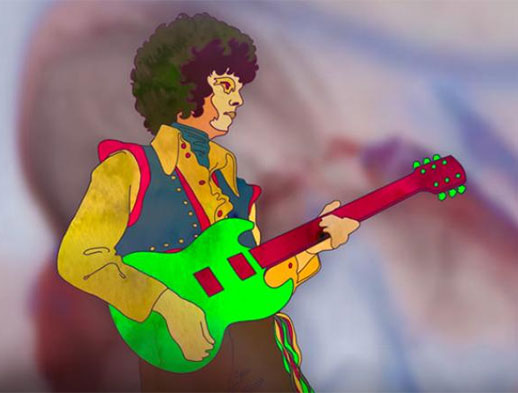
The animated music video, which you can check out below, shows the guitarist at several different stages of his long career. It kicks off with a new Clapton portrait by Peter Blake, the artist responsible for the Beatles’ iconic Sgt. Pepper’s Lonely Hearts Club Band album cover.
I Still Do reunites Clapton with producer Glyn Johns, who was at the helm in the late Seventies, when Clapton recorded Slowhand and Backless.
"He's calmed down a bit," Clapton told Guitar World. "He’s very forthright. He doesn't waste time or words getting to the point. If he thinks you're on to something, he's very enthusiastic and encouraging. If he thinks you're going in the wrong direction, he'll try and shut it down. He's good to work with in that respect. And I like people who are direct, people who know what they’re listening to."
For the complete interview, check out the July 2016 issue of Guitar World, which will be available this week.
I Still Do is available for pre-order on iTunes; three songs—"Can't Let You Do It," "Stones in My Passway" and "Catch the Blues"—are available for purchase right now.
GuitarBlog: Jazz Blues Guitar: Horn-Style Filler Licks...
This week on the GuitarBlog I cover the concept of Jazz Blues Guitar: Horn-Style Filler Licks.
This is a really cool sounding technique that blues and jazz guitar players (as well as guitarists from other styles) will add into their rhythm playing.
By performing small two and three-note chords - used as filler ideas around rhythm parts - we can mimic the effect of horn parts, (the sax or trumpet ideas in jazz and blues bands).
Once a guitarist has their basic blues chords down (and they can play them in context of a 12 or an 8-bar blues), the horn-shot ideas become a great additional technique, (one that isn't all that difficult to perform).
Also, once a guitarist will learn to add a few of these horn-shots into the mix, they'll tend to be quite easy to expand upon. In time, it won't take long for a few of these ideas to turn into many more variations.
In this lesson, I'm going to introduce a few of these "Horn-shot" licks and help you with getting started into what I'm sure will be a really fun technique for you to apply in Jazz-Blues - and many other styles. Enjoy the lesson!
Welcome to, "Figure it Out Fridays: Lesson 007 - Part Two," Ear Training Guitar Lesson.
Here's the Answer Key for, "Figure it Out Fridays," Ear Training Lesson 007.
In this series, we study how to transcribe a new guitar melody or chord progression every week. Musical ideas are released on Tuesday, with the Music and TAB's released that same week on Fridays. Do your best on the days "in between" to learn the different guitar parts.
Up-Load your guess of Tuesdays guitar idea (from the part one lesson) to your YouTube channel. Share your examples on; GooglePlus, Twitter and on FaceBook.
Be sure to check-out the "Part Two" video released every Friday to learn exactly how Tuesdays guitar part looks charted to TAB and in Music Notation. Enjoy the series!
There are times when rushing builds excitement, and then there are times when it detracts – or worse, makes the song unplayable...
Here are two scenarios that might sound familiar. In the first one, you and your band sit down to hear a live recording of your show, and your first thought is, "Wow, that’s fast!" In the second one, you’re playing a difficult piece and suddenly come to a section that can’t be played because the tempo is impossible!
Live shows cause an adrenaline rush, and that energy, all too often, makes players rush. This is not always a rookie problem. It happens with certain players on certain songs. If it’s your drummer who’s rushing, it can be almost impossible to resist the urge to pick up the tempo, too. There are times when rushing builds excitement, and then there are times when it detracts – or worse, makes the song unplayable. Fortunately, this is not a new problem. Drummers are full of helpful hints on this matter, some of them decidedly zen-like. Here are a few of those tips...
1. Focus on the rests
Take things back to the fundamentals. Imagine a quarter note, then two quarter rests, then another quarter note. When you were a beginner musician, did your first teacher ever remind you to give the rests their full value?
In the art of music, "space" can be as expressive as "sound." Don’t short-change the silence in your songs just to get to the next beat. Focusing on those rests will prevent you from shortening up the end of a measure, and the correct feel of the down-beat into the next one.
2. Send a reminder to your right brain
This self-coaching practice can take many forms. For some, it’s looking at sheet music and focusing on the white paper under the black ink – the canvas upon which the song is painted. Some players might tape an index card that reads "pace" to a music stand. Or you could take a moment to intentionally relax yourself and say something internally about keeping really good /solid time.
These might sound silly concepts to some, or obvious to others, but in a well-rehearsed band, you’re always trying to get into "the zone," (that place beyond conscious thought in which the songs seem to play themselves through your hands). In that place, your right brain controls your breathing and your heartbeat without volition and without mistake. In this unconscious place, your playing will be as constant as the beat of your heart.I know it sounds weird, but trust me, the more you are able to focus on your unconscious mind, the better you will be with respect to the beat in the music.
3. Lock in with a band-mate
Chances are, there’s someone in your band who has terrific tempo, someone with whom you consistently lock in. Now, ideally it's your drummer, but sometimes, it might be the bass-player, guitarist or keyboard player. Focusing on that player during difficult sections will get you through without tempo problems and without the effort of thinking about it. This "two-person lift effect" is responsible for the steady groove that most bands try to attain. Of course, it’s always better if the whole band can lock into the feel this way. That’s a magical achievement that will make your band sound intense and powerful.
4. Address technical issues
Is there a particular song, section, or fill that’s making you stumble? Practicing that part with intensity can correct the problem. Play through the part at a slower tempo so that you can analyze the details. When do you feel tension? When do you feel relaxed? Can you change something in the part to make for an easier transition? For example, could you change a hit from the floor tom to the left rack tom to make for a shorter throw back to the snare or hi-hat? Is there a pick-up note on your bass guitar part that you could accent? Or, how about a particular beat on your rhythm guitar strums that can lock you into the feel better? Being slightly overtaxed physically makes players overcompensate; groove and tempo will often suffer as a result.By paying more attention, you'll lock up into the rhythmic meter and play your parts with more precision.
5. Play to an intermittent click track
Obviously, working with a click track can fix the tempo in your head, helping you obtain perfect rhythm in the same way that a classical cellist might have perfect pitch. However, used too often, this can become a crutch, especially since most players don’t use an electronic beat-box onstage.
One method to constantly self-test and correct your tempo is to use an intermittent click. Using a metronome, (or a computer, phone app, or whatever time-keeping tool you have), program a click track that periodically drops out for a measure or two and practice playing to that. When you come right back in on the one, after two measures without the click, you’ll know you’ve mastered the time.
6. Follow the drummer
The drummer (a good drummer) supports and enhances what other players do. Drummers onstage should not be biding their time until the next big fill, trying to dominate the crowd’s attention. if you have a drummer like that, it's time for a serious talk, or maybe even something more drastic like a; "you're fired." The group should work together to express a great song, which means good listening from everyone. Also, players should have a low ego, and not somebody who's constantly being a "now for my next trick" musician. Listening, interacting and "doing what’s right" for the song will ensure that every beat matters in the context of the song. A band member who is just filling space until some dramatic showoff piece isn't worth keeping in the act. Showing off isn’t always bad, of course. It’s just that the song is about more than that, and needs to be played that way.
7. Use technology Building your skills as a timekeeper is a matter of continued attention and practice. If you want to go beyond the metronome, gadgets exist that will actually time you rather than just counting. Such a timekeeping tool will measure the space between hits, inform you about your pace in terms of beats per minute, and let you know in real time when you’re wavering. These are obviously a very helpful thing to know as you keep on striving to be both a great musician and have a great band.
Jesse Sterling Harrison is an author, recording artist, and part-time farmer. He lives in Massachusetts with his wife, three daughters, and a herd of ducks.
Its manufacturer, Mind Music Labs, refers to the Sensus as "the first real smart guitar in the world, designed to satisfy the needs of contemporary musicians looking for new sounds and new ways to express themselves and reach more people."
According to the company, "all sounds and effects [in the video] can be obtained without the help of any accessory or computer: [it's] 100 percent Sensus Smart Guitar sound!"
Here are a few Sensus factoids from Mind Music Labs':
"Sensus is at the same time a real guitar, a 360-degree wireless music system and a true IoT device: if feels and plays like a guitar, but its innovative technology evolves what a guitar can do and allows its wooden body to produce any sound and modulation, always in high fidelity, and to take full advantage of Internet connectivity."
"Sensus feels like a guitar and is built with the same wood of Stradivari violins. Like any guitar, Sensus produces sound thanks to the vibration of real strings. The vibration is transmitted to the wooden body of the guitar, and its vibration is what produces the music you hear."
"With Sensus, you can add infinite modulations and effects to your music in a natural, beautiful way, with no need for amplifiers or accessories. You can also stream and play directly on your favorite songs, or jam together with a friend at a distance, listen to what you just played and immediately share your performances online. Of course, you can also perform on big stages taking advantage of Sensus’ IoT features to add new levels or expression and interaction to your performances, or record music in studio-level quality straight from the guitar." The video, which features a performance by guitarist Valerio Fuiano, shows the expressive potential of the Sensus.
For more information, check out the video below and visit http://www.mindmusiclabs.com/.